
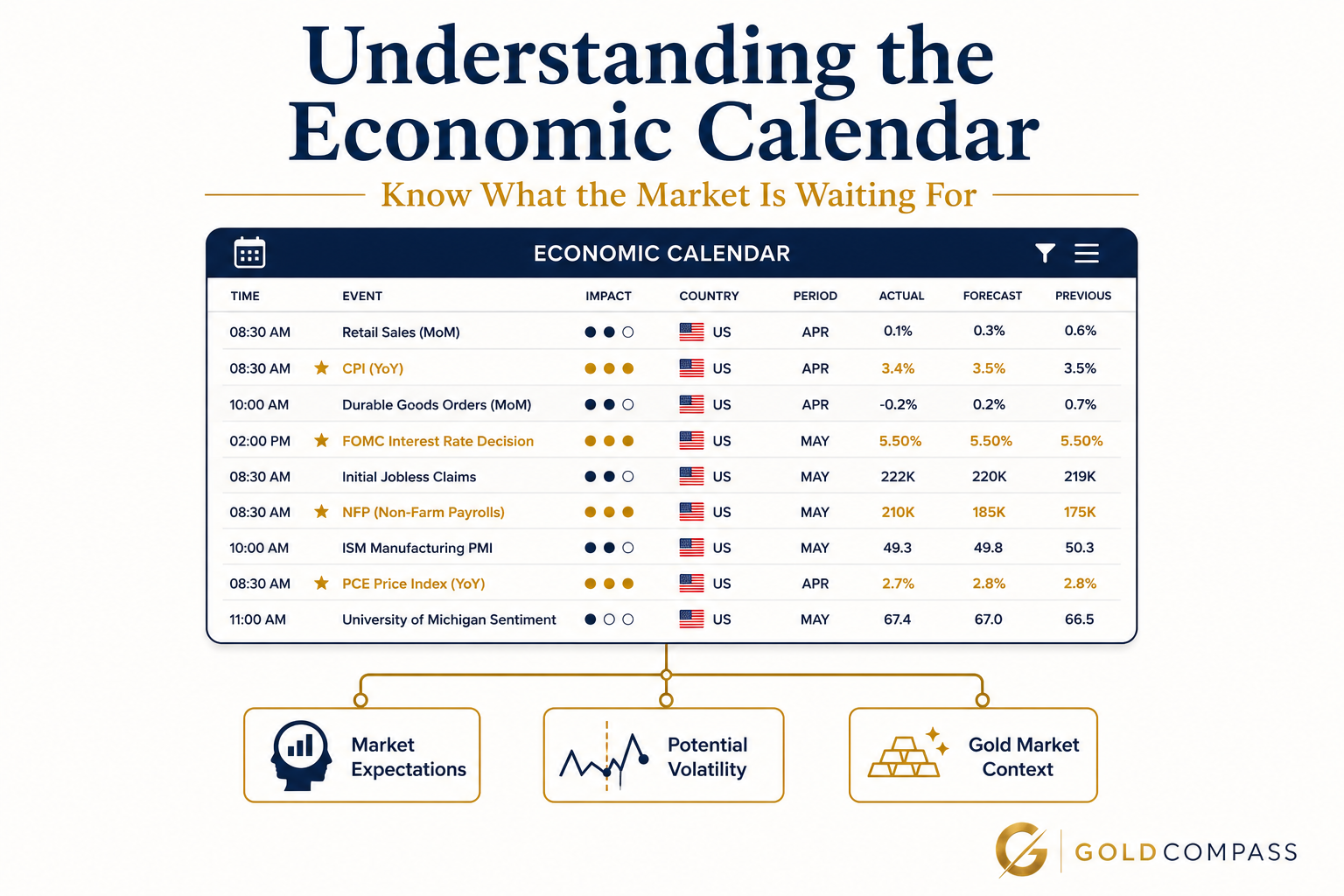
Understanding the Economic Calendar
In the previous article, we learned that markets often react to the difference between expectations and reality.
That raises an important practical question:
How do you know when the information capable of changing those expectations will arrive?
The answer begins with the economic calendar.
An economic calendar organizes scheduled reports, central-bank decisions, speeches, and other events that financial markets may follow.
For gold traders, checking the calendar is not about predicting what gold will do.
It is about knowing when important new information is scheduled to enter the market.
1. What Is an Economic Calendar?
An economic calendar is a schedule of upcoming economic events and data releases.
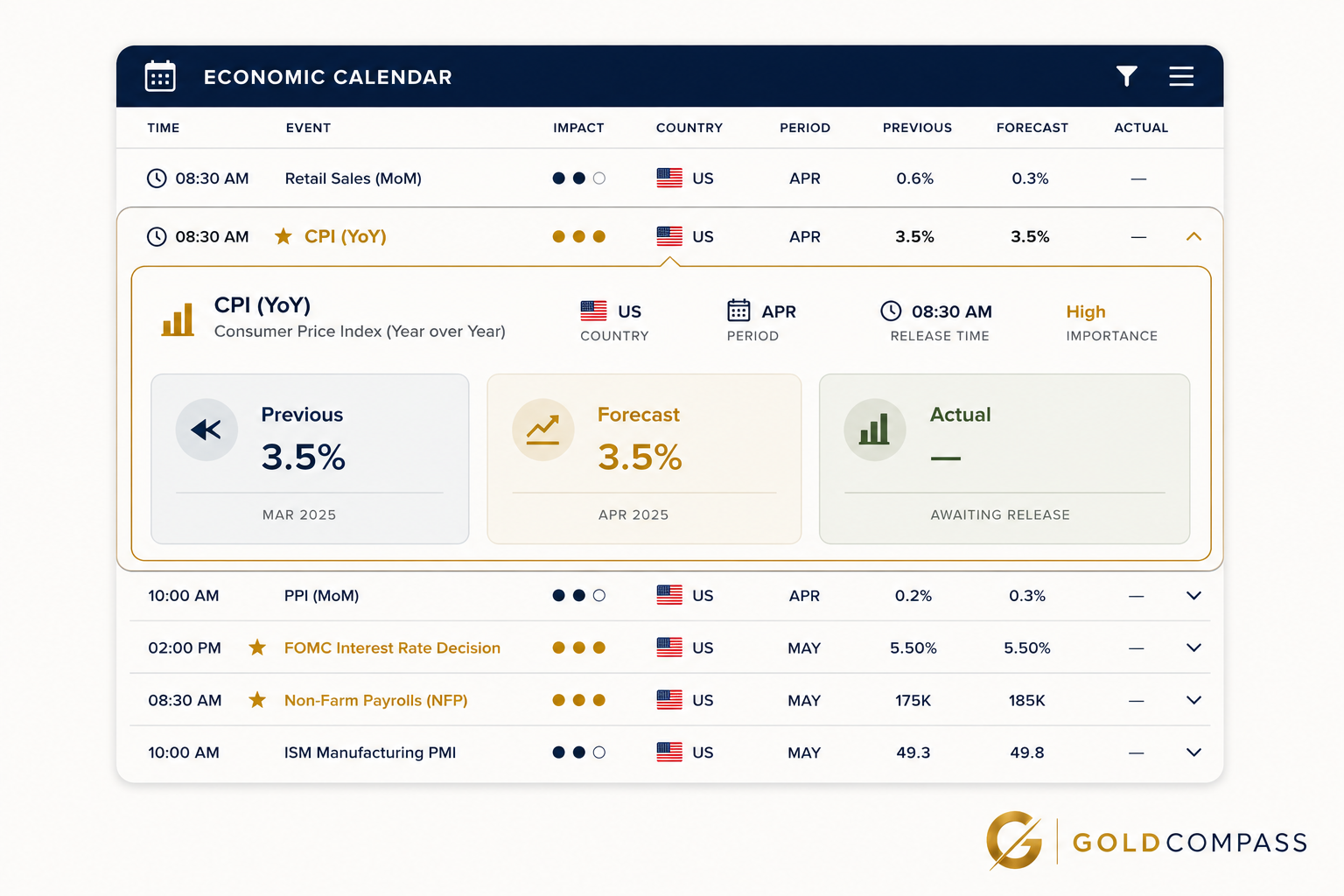
Depending on the calendar, an event may display:
- Release date
- Release time
- Country or economy
- Event name
- Expected importance
- Previous result
- Forecast
- Actual result after publication
Before the event, Previous and Forecast provide context.
When the event occurs, Actual becomes available.
The market can then compare what happened with what had been expected.
This makes the economic calendar the practical starting point for the expectation framework introduced in the previous article.
2. Why the Calendar Matters for Gold
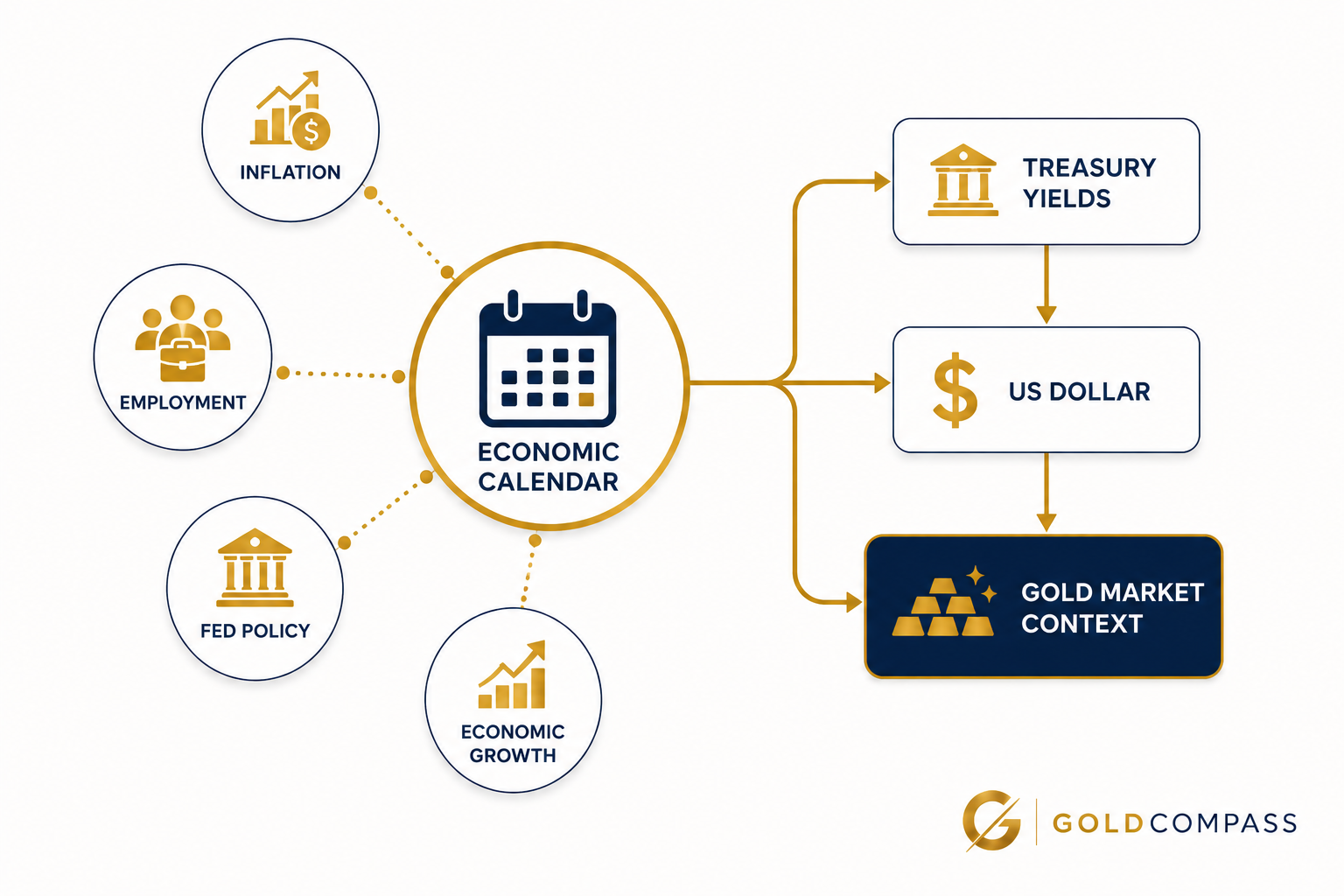
Gold trades within a global macroeconomic environment.
Economic information can change expectations about inflation, growth, employment, and monetary policy.
Those changes can influence Treasury yields, the US Dollar, and investor positioning.
For that reason, certain scheduled events can coincide with significant changes in gold-market volatility.
The calendar helps answer a basic but important question:
Is there an important event approaching that could change the current market environment?
Knowing that an event is coming does not tell you the direction of the next move.
It tells you that new information is about to arrive.
3. Not Every Event Has the Same Importance
Economic calendars can contain many events during a single trading day.
Treating every release as equally important would create unnecessary noise.
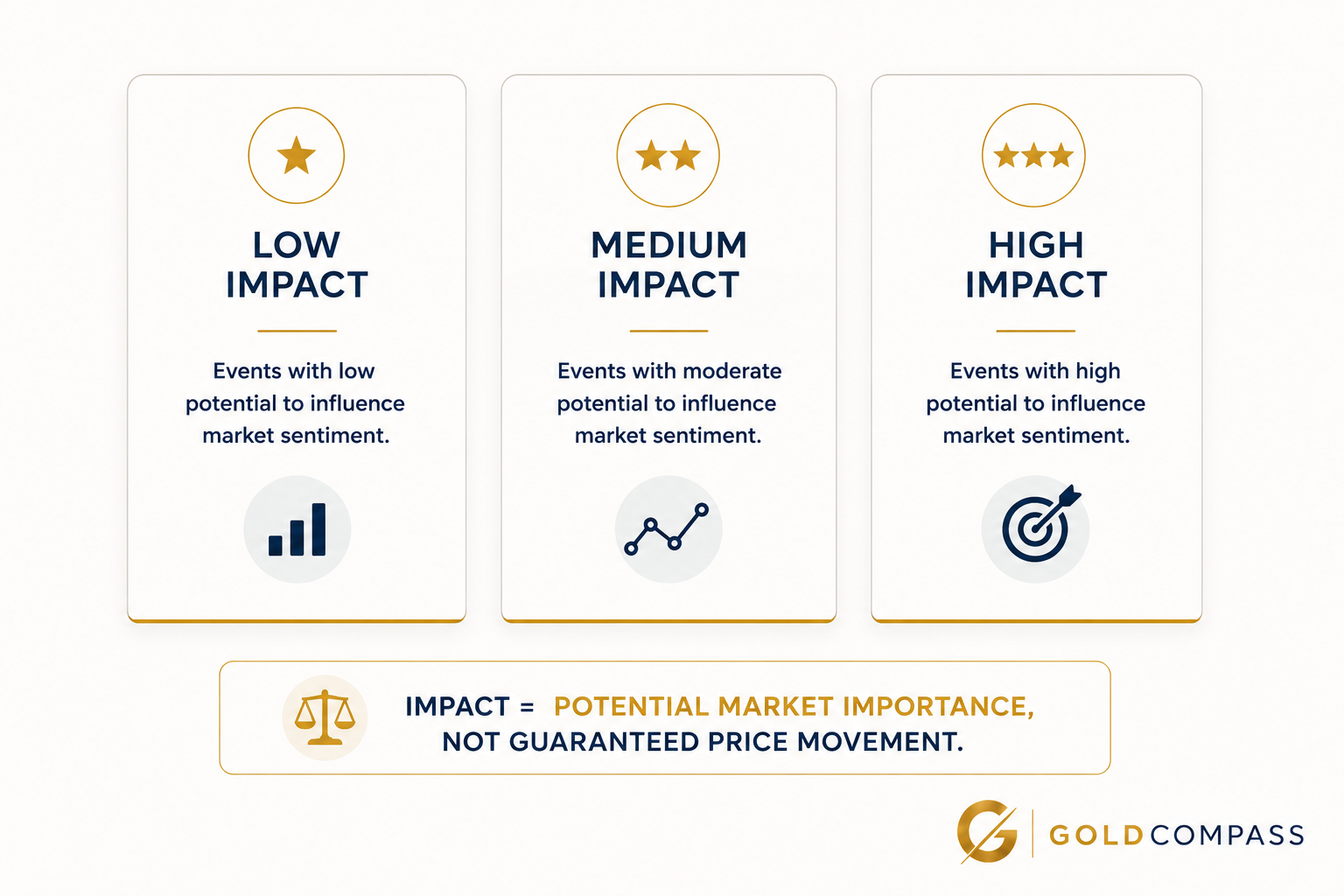
Calendars therefore commonly classify events by expected market importance.
Low-impact events generally receive less attention from global markets.
Medium-impact events may become important depending on current economic conditions.
High-impact events are more likely to attract substantial institutional attention and can coincide with increased volatility.
However, an important distinction remains:
High impact does not mean guaranteed large price movement.
A major report can arrive almost exactly as expected and produce a relatively restrained response.
Conversely, an unusually surprising result can become important very quickly.
4. The Major Events Gold Traders Commonly Monitor
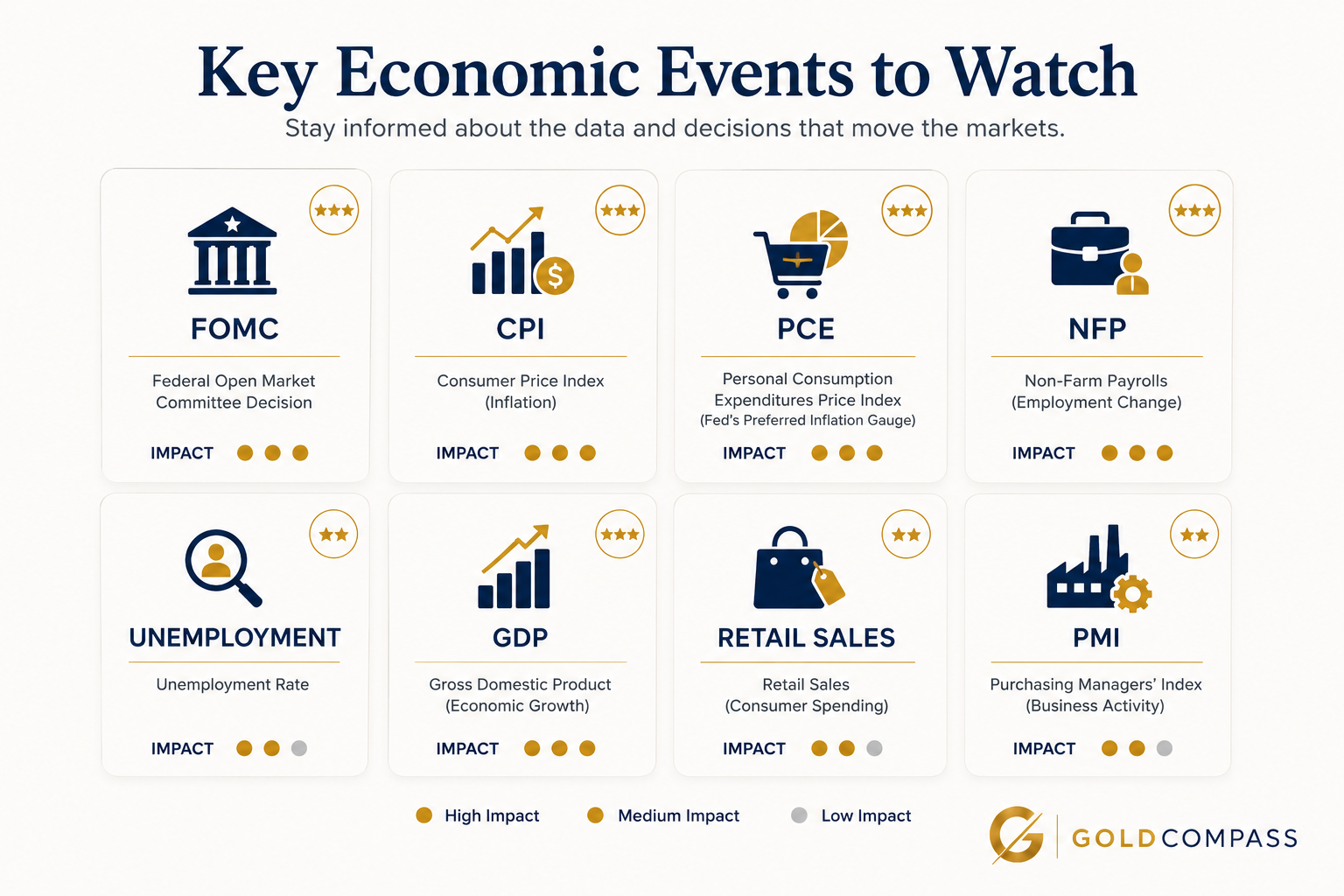
Hundreds of economic indicators exist, but gold traders tend to pay particular attention to reports capable of changing expectations about inflation, employment, economic growth, or Federal Reserve policy.
Some of the most closely watched events include:
FOMC Interest Rate Decisions
Federal Reserve decisions can directly change monetary-policy expectations.
Federal Reserve Press Conferences and Speeches
The language used by policymakers can alter expectations even when interest rates remain unchanged.
Consumer Price Index (CPI)
A major measure of consumer inflation.
Personal Consumption Expenditures Price Index (PCE)
An important inflation measure used in Federal Reserve analysis.
Non-Farm Payrolls (NFP)
A major report on US employment conditions.
Unemployment Rate
Provides another perspective on labor-market strength or weakness.
Average Hourly Earnings
Wage growth can contribute to the market's assessment of inflation pressure.
Gross Domestic Product (GDP)
Provides information about the pace of economic growth.
Retail Sales
Offers insight into consumer spending.
Purchasing Managers' Indexes (PMI)
Provide information about business activity in manufacturing and services.
Not every release will matter equally every month.
The market's current concern determines which information receives the most attention.
5. Previous, Forecast, and Actual on the Calendar
The three values introduced in the previous article become especially useful on an economic calendar.
Previous provides historical context.
Forecast represents the consensus expectation before the release.
Actual reveals the newly reported information.
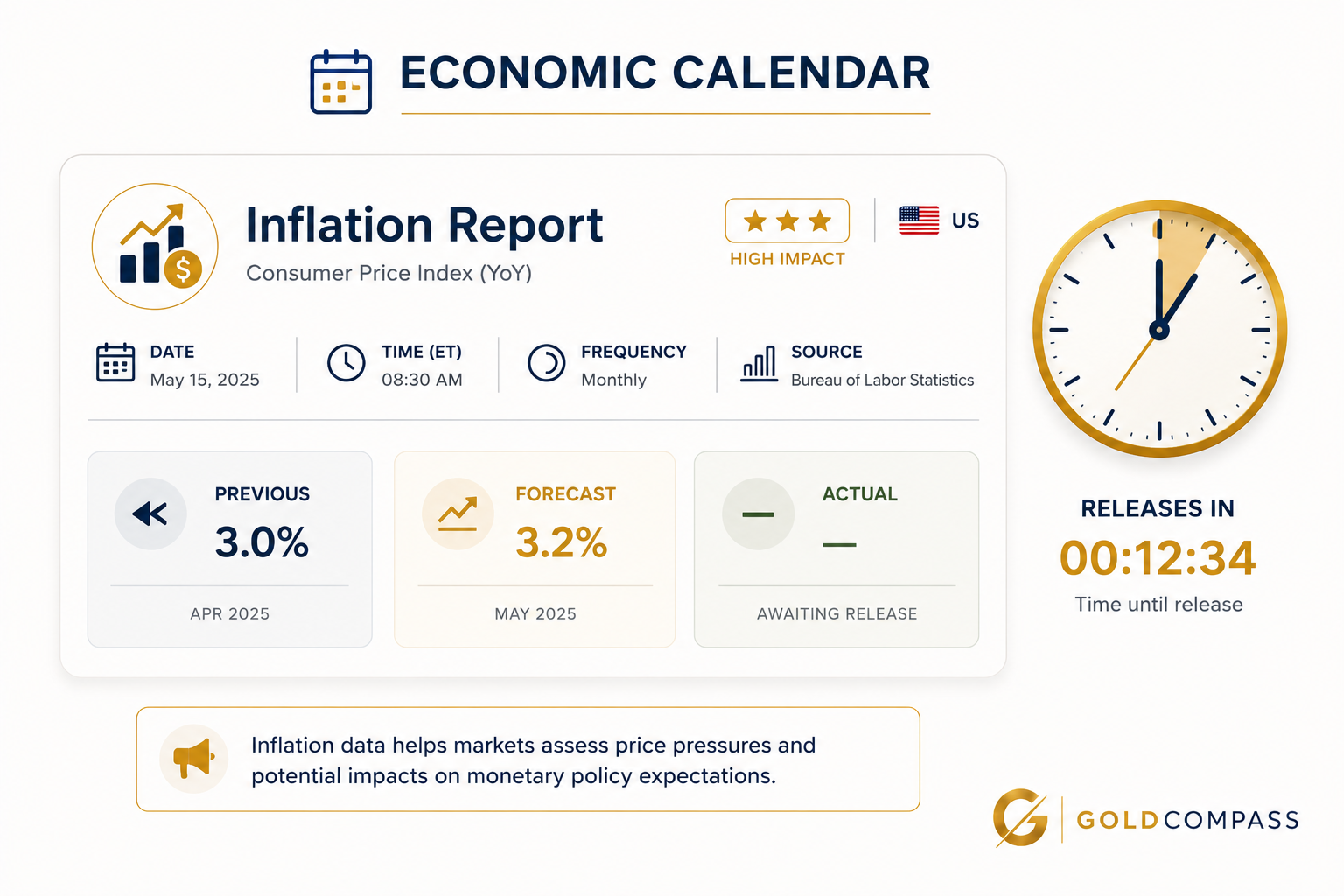
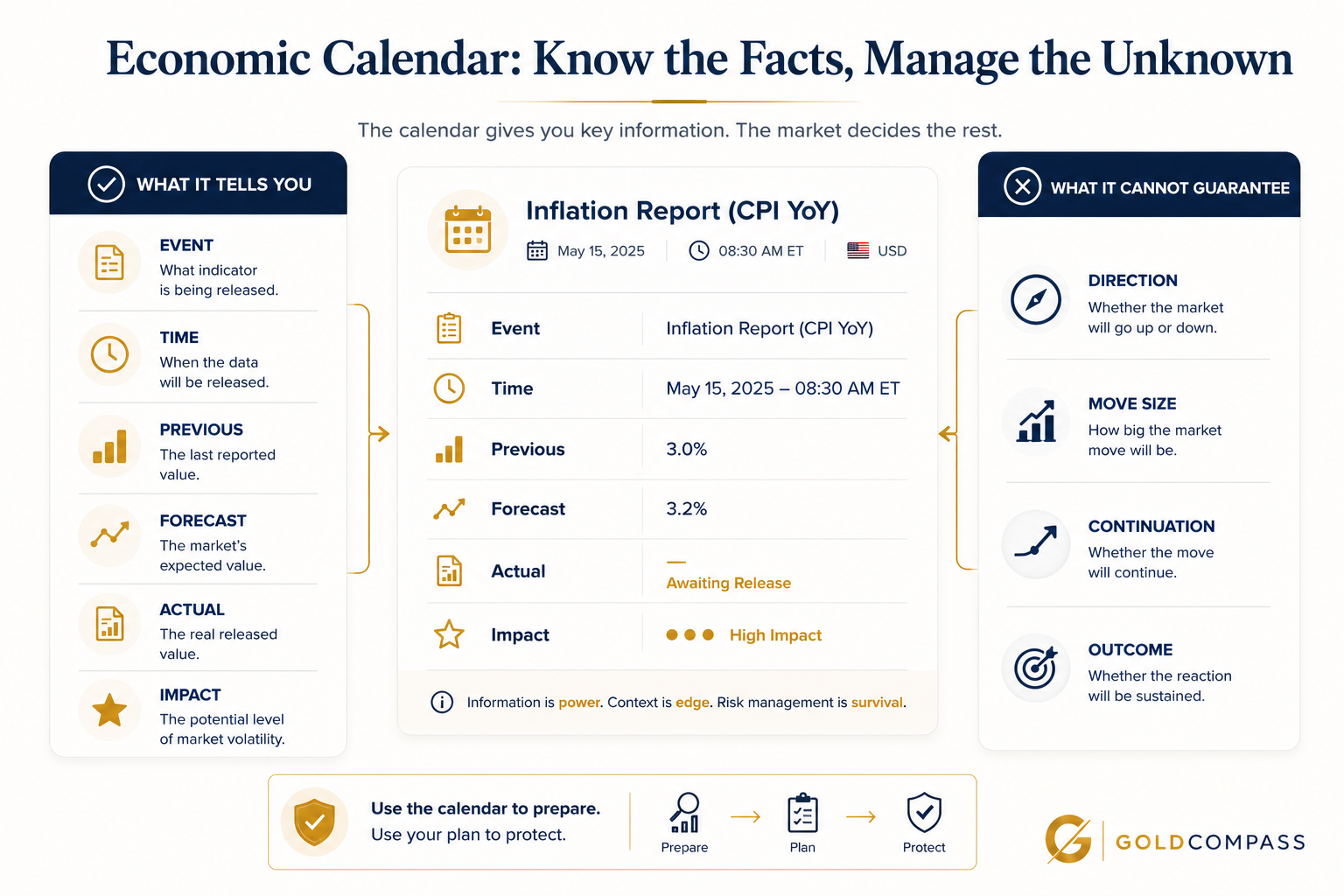
Suppose an inflation report displays:
Previous: 3.0%
Forecast: 3.2%
Before publication, the trader already knows two important things.
Inflation was previously 3.0%, and economists broadly expect it to increase to 3.2%.
When Actual appears, the market can immediately compare the new information with that expectation.
This is why checking the calendar before an event is more useful than discovering the event after gold has already moved.
6. Why Release Time Matters
Economic data is published at scheduled times.
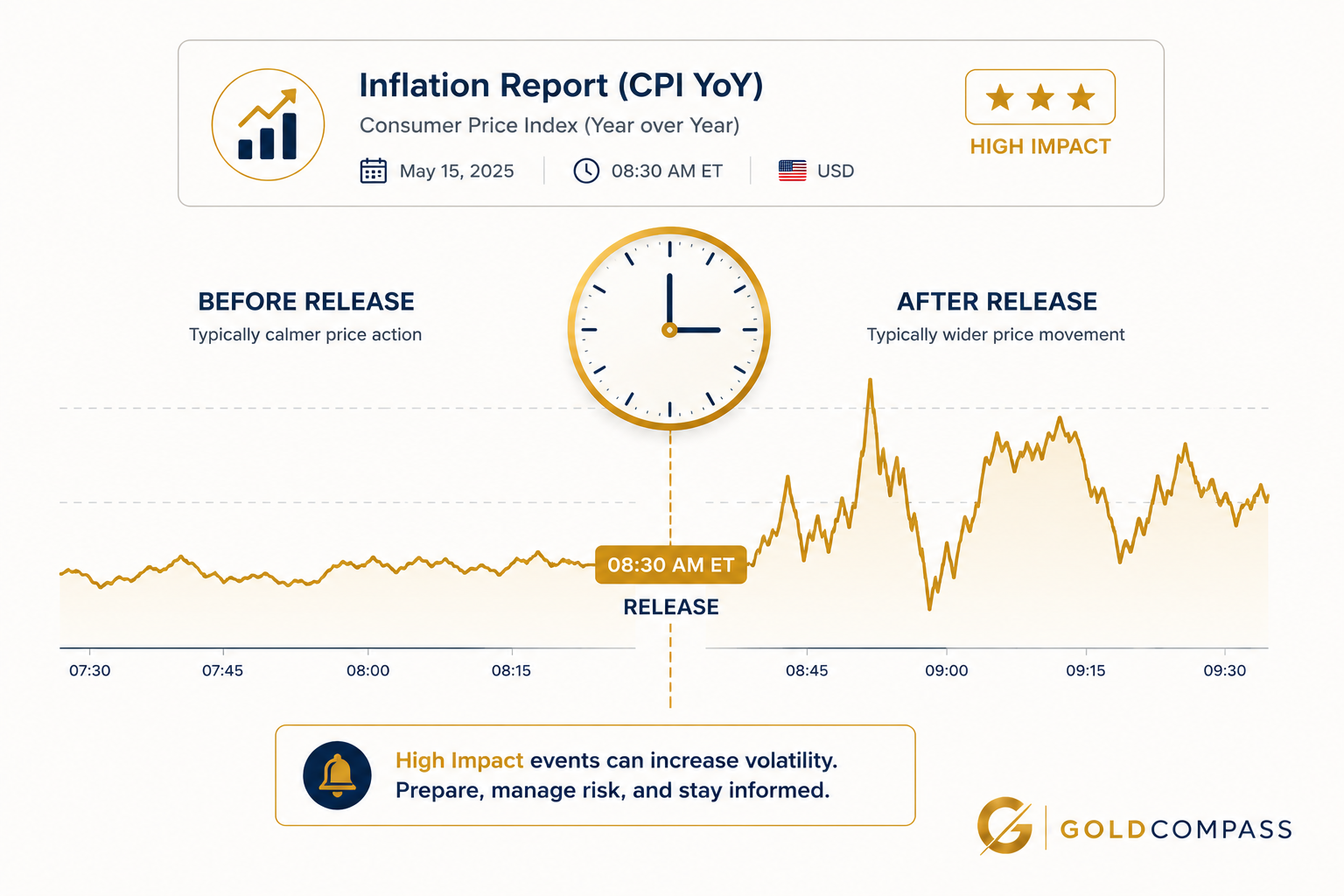
Around major releases, market conditions can change rapidly.
Gold may experience:
- Faster price movement
- Wider short-term price ranges
- Rapid changes in Treasury yields
- Sudden US Dollar movement
- Short-lived price reversals
- Increased uncertainty
Knowing the release time allows traders to recognize that market conditions immediately before and after an important announcement may differ from normal conditions.
This is especially relevant for short-term traders.
A setup that appears calm several minutes before major data may enter a very different volatility environment once the report is published.
7. Scheduled Risk Is Different From Unexpected Risk
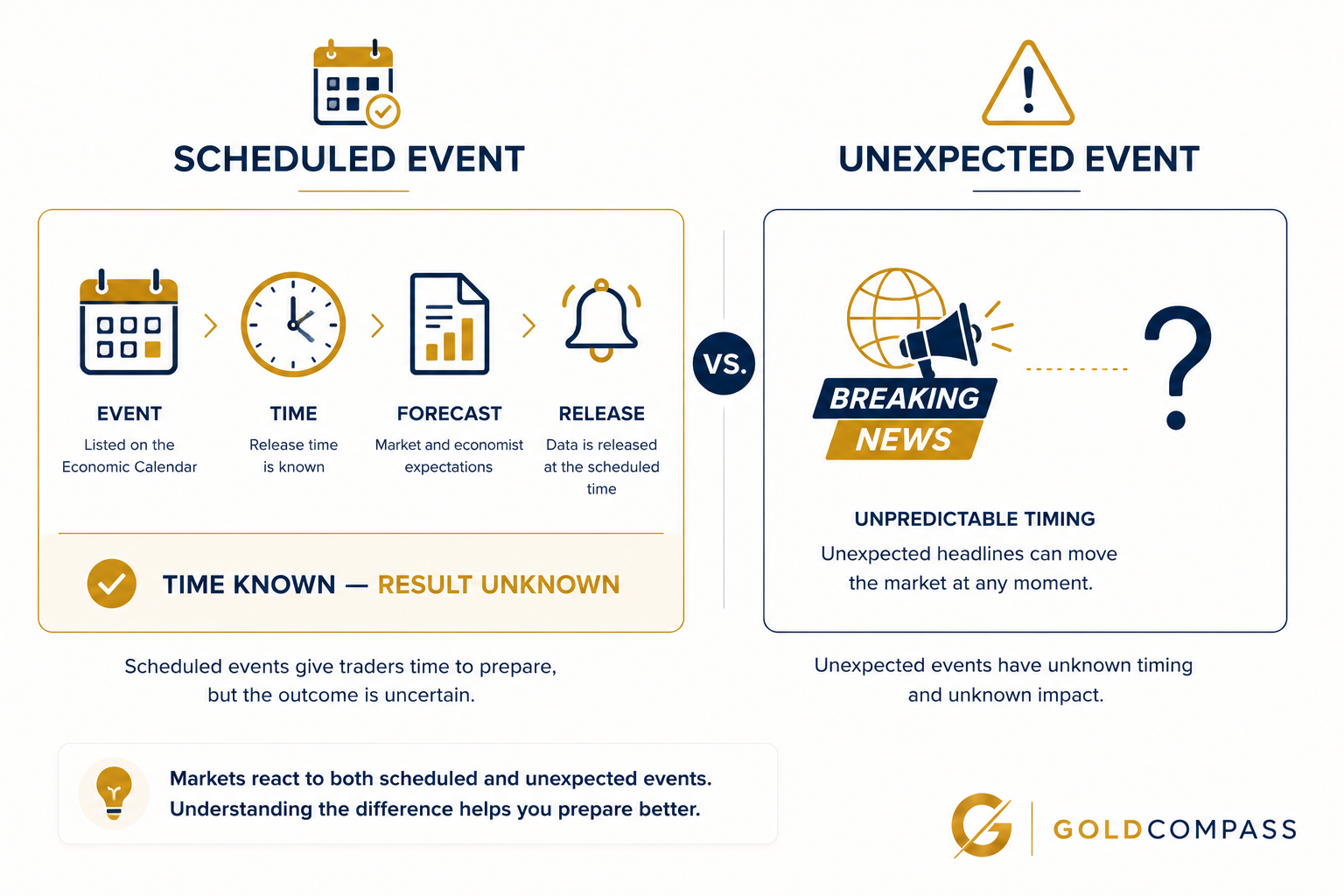
One major advantage of an economic calendar is that many important events are known in advance.
You cannot know the result beforehand.
But you can know when the result is scheduled to arrive.
That makes scheduled economic events different from unexpected geopolitical headlines, emergency policy announcements, or sudden market disruptions.
With scheduled events, preparation is possible.
A trader can review the event, understand expectations, evaluate existing market conditions, and consider whether their risk exposure remains appropriate.
The calendar does not remove uncertainty.
It makes part of that uncertainty visible in advance.
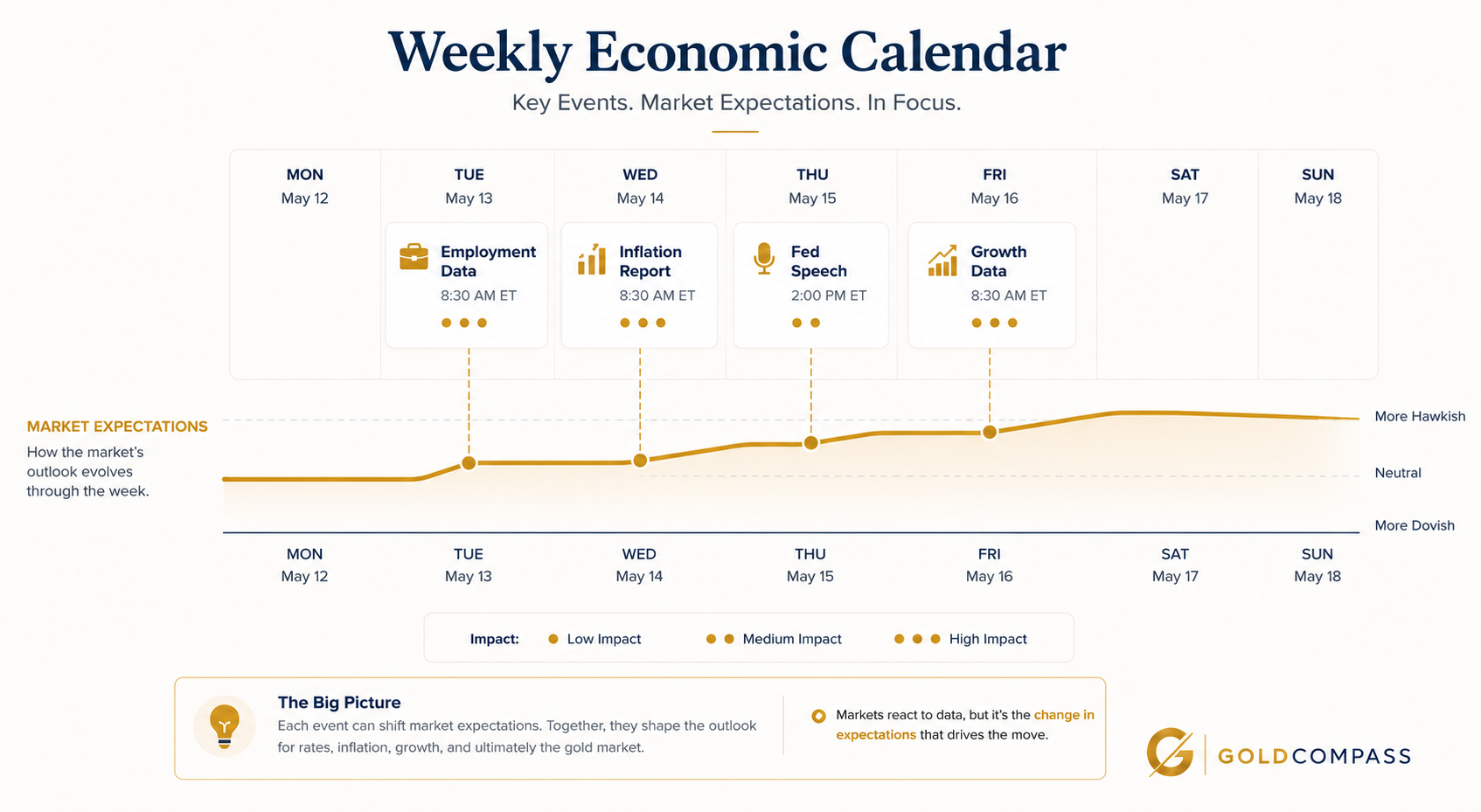
8. Watch for Clusters of Important Events
Sometimes several major reports occur within a short period.
For example, a week might contain employment data, inflation data, and an important Federal Reserve communication.
Each event can alter expectations before the next event occurs.
This means traders should not always analyze calendar events independently.
The broader sequence matters.
If one report changes the market's inflation outlook, the next Federal Reserve speech may suddenly receive more attention.
If employment data significantly weakens, the importance of upcoming growth indicators may increase.
The economic calendar therefore becomes more useful when viewed as a timeline of changing information, not merely a list of isolated announcements.
9. How to Prepare Before a High-Impact Event
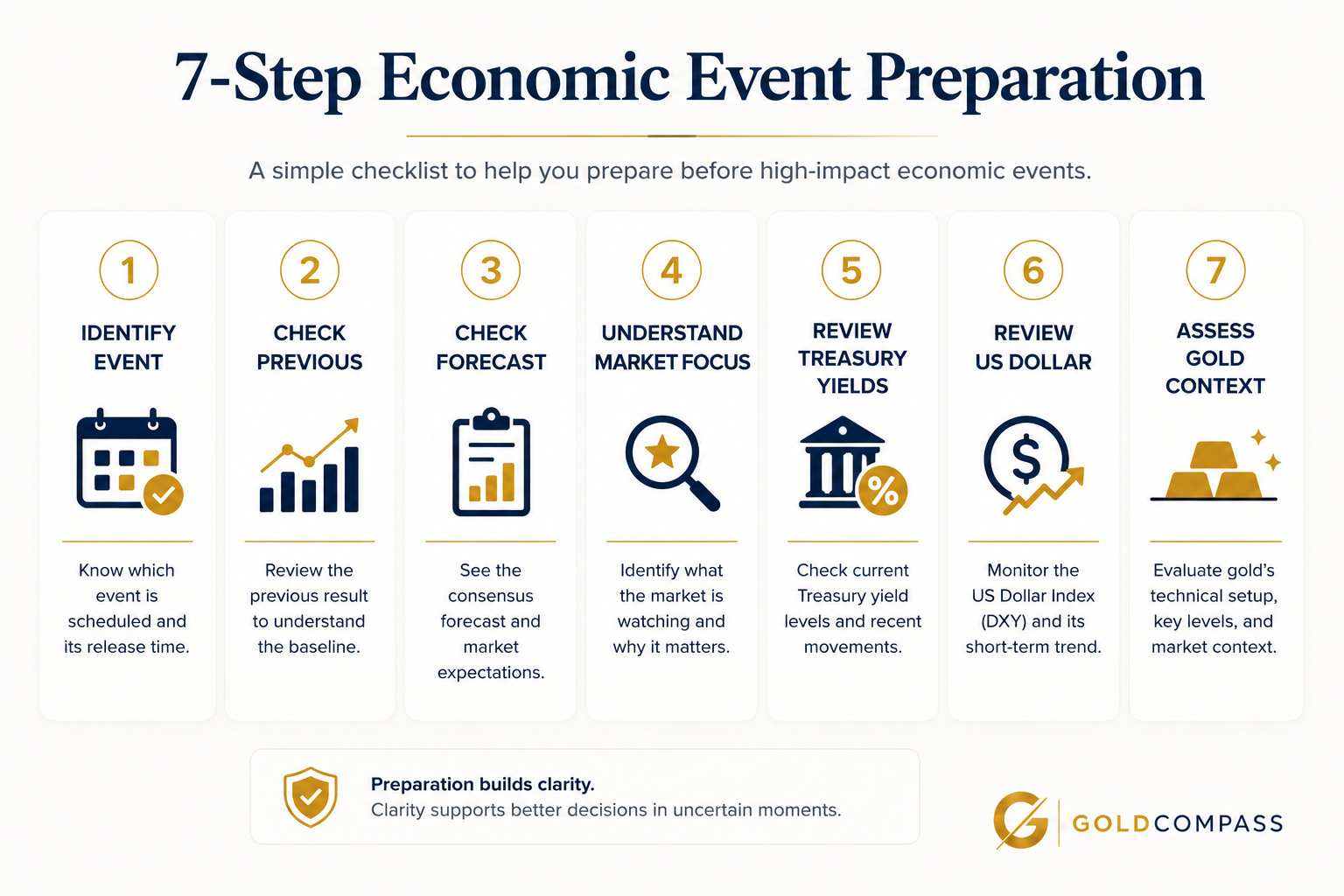
A structured preparation routine can make economic-calendar information more useful.
Before an important event, identify exactly what is being released.
Check the Previous result.
Review the Forecast.
Understand what the market is currently focused on.
Look at the existing direction of Treasury yields and the US Dollar.
Identify whether gold is already experiencing elevated volatility.
Finally, remember that knowing the expected result does not mean knowing the market reaction.
The objective is preparation—not prediction.
10. What to Watch After the Release
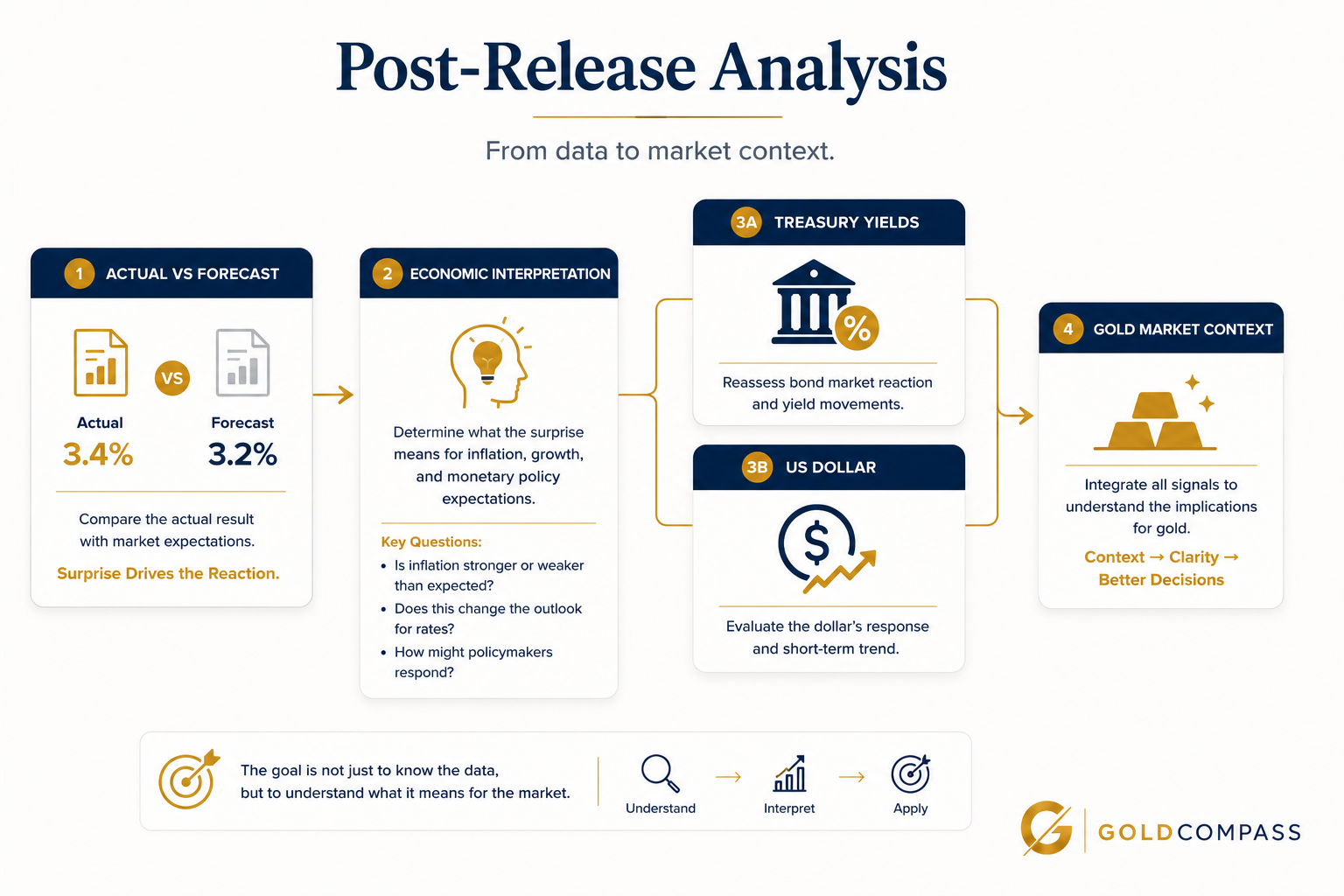
Once Actual becomes available, avoid focusing only on whether gold initially moves up or down.
First compare Actual with Forecast.
Then determine whether the difference is meaningful.
Next consider whether the result changes the broader economic narrative.
Watch how Treasury yields respond.
Watch how the US Dollar responds.
Then evaluate gold's behavior within that context.
This is especially useful when the initial gold reaction seems inconsistent with the headline.
The connected markets may reveal how investors are actually interpreting the information.
11. What the Economic Calendar Cannot Tell You
An economic calendar is a preparation tool.
It is not a prediction engine.
It cannot reliably tell you:
- Whether gold will rise or fall
- How large the market reaction will be
- Whether the first move will continue
- Whether a surprise has already been partly anticipated
- How traders are positioned before the event
- Whether another simultaneous development will dominate the market
This distinction matters.
The calendar tells you what is scheduled and when.
Market analysis determines how that information fits into the broader environment.
12. Build the Calendar Into Your Daily Routine
Checking the economic calendar should happen before detailed short-term market analysis.
A simple routine is enough.
Start by reviewing today's high-impact events.
Note their release times.
Check whether several major events are clustered together.
Review Previous and Forecast values.
Then place those events within the current macroeconomic environment.
This creates a better foundation for understanding what happens later in the trading session.
The calendar does not tell you what trade to make.
It tells you when the market may receive information capable of changing the story.
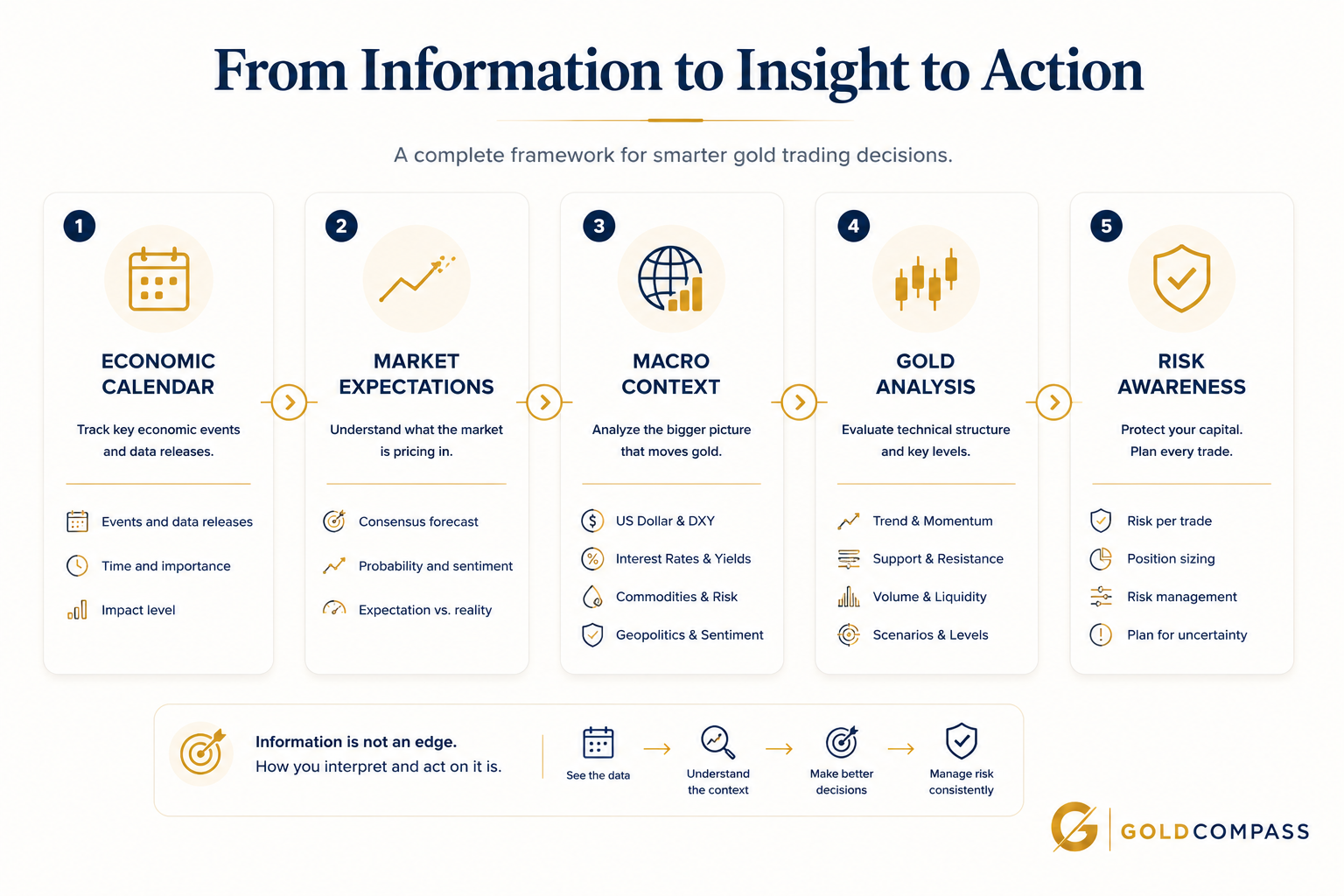
Key Takeaways
- An economic calendar shows when scheduled economic information will be released.
- Gold traders commonly monitor events related to inflation, employment, economic growth, and Federal Reserve policy.
- High-impact classification indicates potential importance, not guaranteed volatility or direction.
- Previous, Forecast, and Actual provide the context needed to interpret a release.
- Knowing the release time helps traders recognize periods when market conditions may change rapidly.
- Scheduled economic events allow preparation even though the result remains unknown.
- Multiple events should sometimes be viewed as a sequence rather than isolated announcements.
- After a release, Treasury yields and the US Dollar can help reveal how markets are interpreting the information.
- An economic calendar is a preparation tool, not a trading signal or price-prediction tool.
Frequently Asked Questions
What is an economic calendar?
An economic calendar is a schedule of economic reports, central-bank events, speeches, and other scheduled information that may affect financial markets.
Which economic events are most important for gold?
FOMC decisions, CPI, PCE, NFP, unemployment data, wage growth, GDP, Retail Sales, and PMI reports are among the events commonly monitored by gold traders. Their relative importance changes with market conditions.
What does high impact mean?
High impact generally indicates that an event is considered capable of attracting significant market attention. It does not guarantee a large price movement.
Why should I check the calendar before trading gold?
It helps identify scheduled events that may introduce new information and potentially change volatility or market expectations.
Does the economic calendar predict whether gold will rise or fall?
No. It shows scheduled information and expectations. The market's reaction depends on the result, existing expectations, positioning, and the broader financial environment.
Why can gold move before an economic report is released?
Markets are forward-looking. Expectations, positioning, related economic information, and changes in Treasury yields or the US Dollar can influence gold before the official release.
Should I only watch US economic events?
US events are particularly important because gold is globally priced in US Dollars and Federal Reserve policy has broad financial-market influence. However, major global economic and geopolitical developments can also affect gold.