
Why Markets React More to Expectations Than the News
A major economic report is released.
The number looks important, yet gold barely moves.
Another report comes out a few weeks later. The difference looks small, but gold suddenly becomes volatile.
Why?
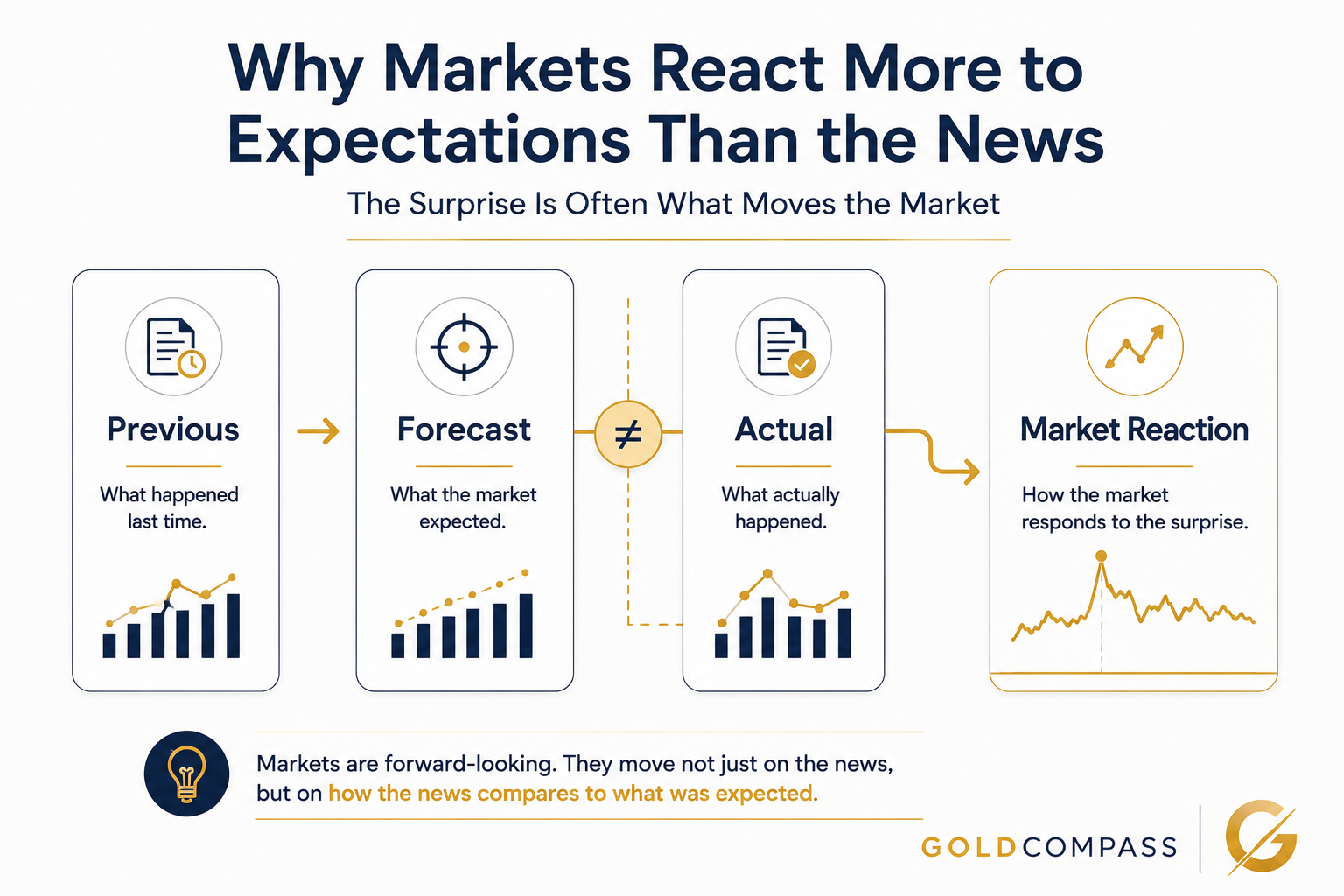
Because financial markets do not evaluate economic news only by asking whether a number is high, low, good, or bad.
They compare the new information with what the market already expected.
That difference between expectation and reality is one of the most important concepts for understanding how markets react to economic news.
1. Markets Are Always Looking Ahead
Financial markets are forward-looking.
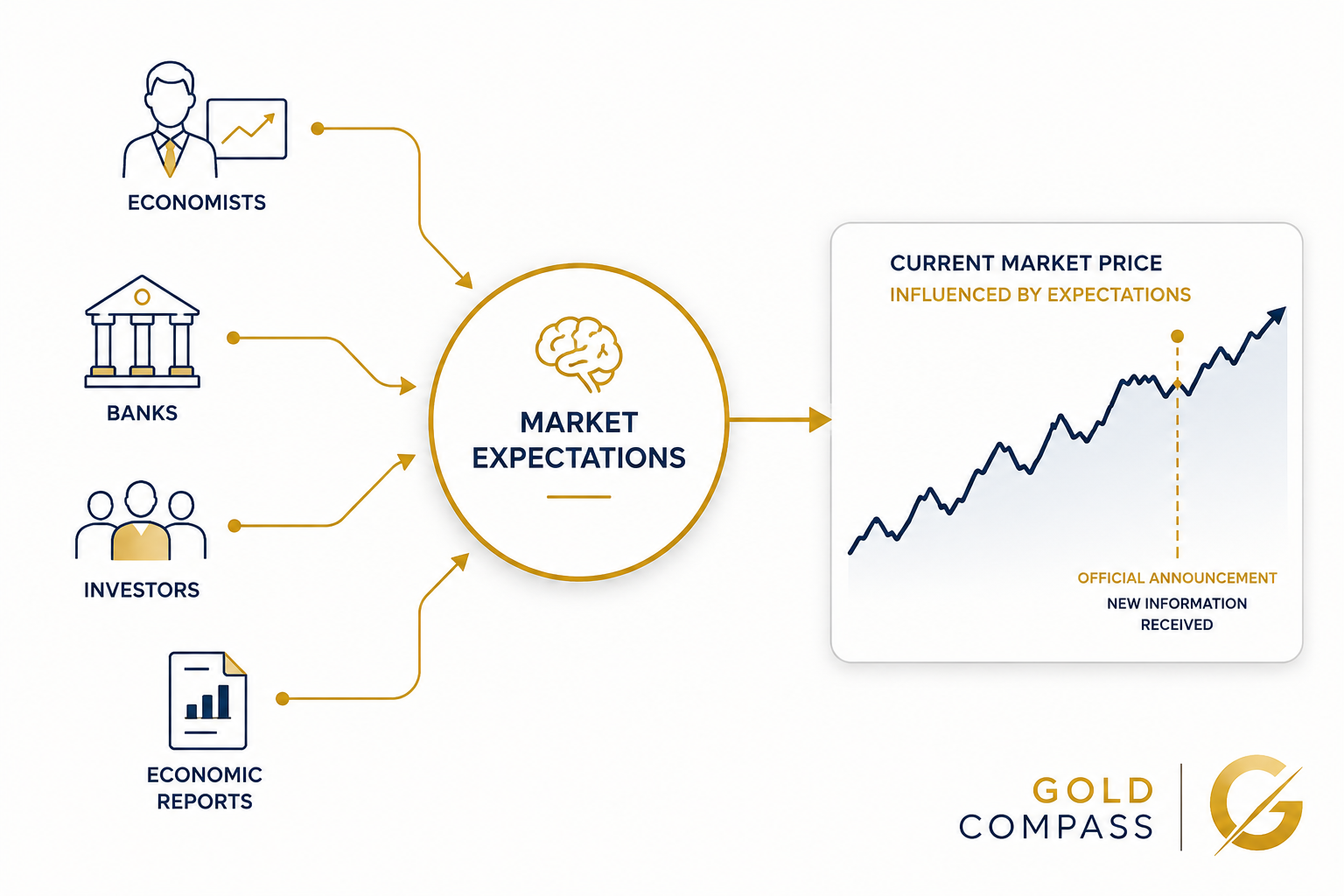
Before CPI, employment data, an FOMC decision, or another major event is released, economists and financial institutions have already formed expectations about what may happen.
Investors can begin adjusting their positions based on those expectations before the announcement.
This is what traders mean when they say something is priced in.
If the official result later matches expectations, the market has learned relatively little that is new.
If the result is significantly different, the market may suddenly need to reconsider its assumptions.
That reassessment can create volatility.
2. Previous, Forecast, and Actual
Most major economic releases provide three important values.
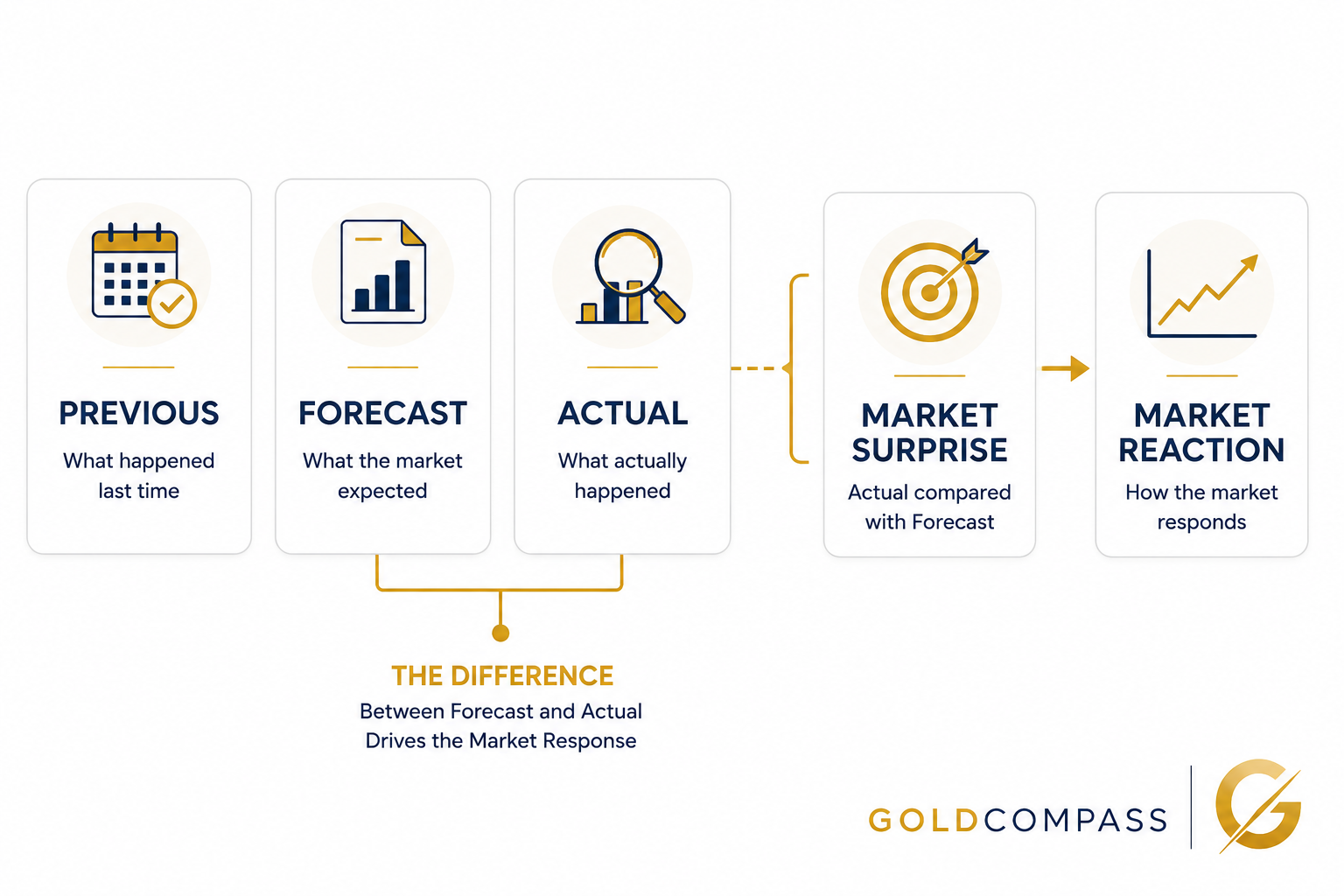
Previous tells you what was reported during the previous period.
Forecast tells you what economists broadly expect from the upcoming report.
Actual is the new result released to the public.
The Actual number matters, but it should not be read by itself.
The comparison between Forecast and Actual is often especially important because it tells us whether the new information surprised the market.
3. The Surprise Is What Changes the Story
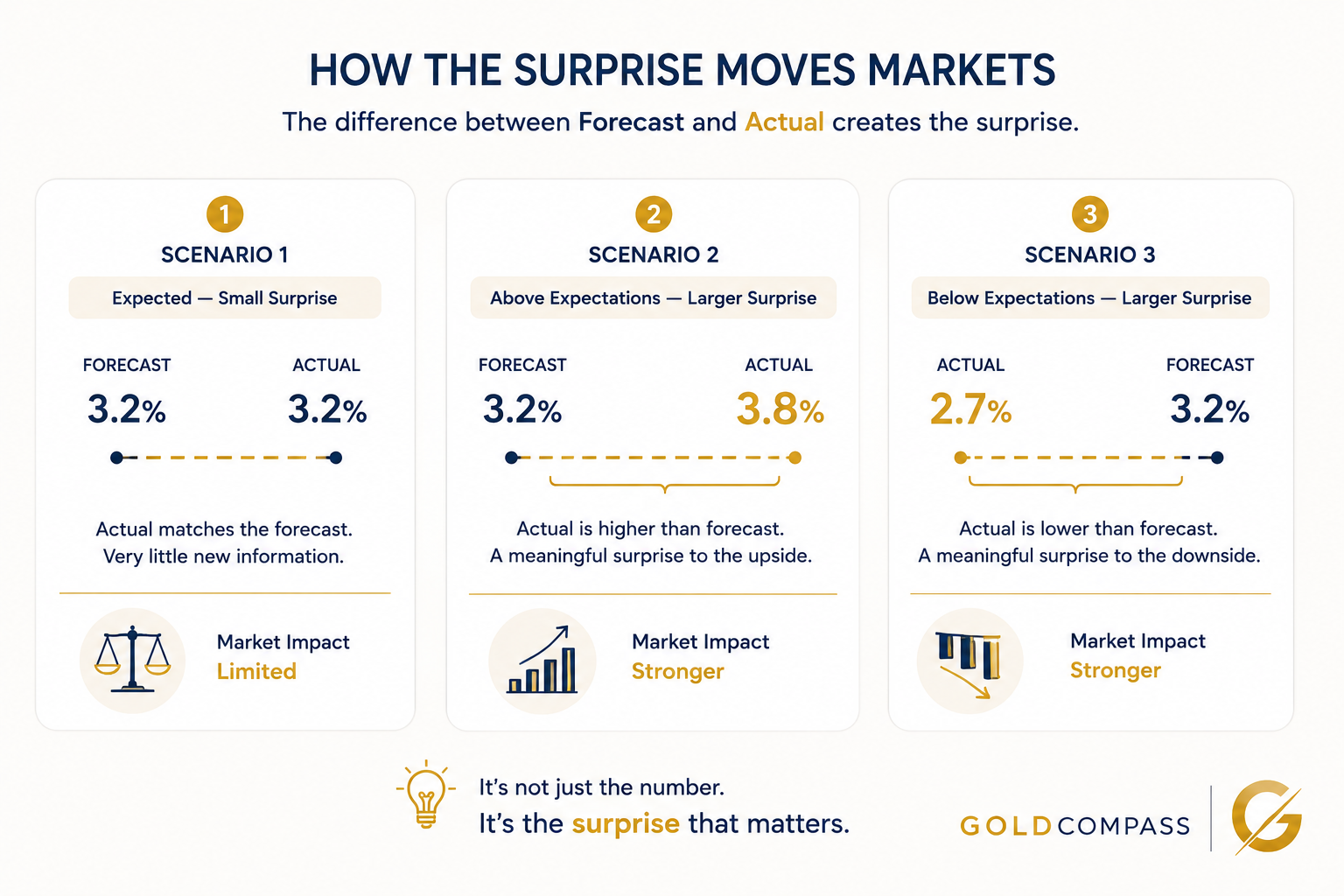
Imagine annual inflation was previously 3.0%.
Economists expect the next report to show 3.2%.
Now consider three different outcomes.
Scenario 1: Actual inflation is 3.2%
The market expected 3.2%.
The report delivers 3.2%.
Inflation increased, but the increase was already expected.
The report therefore provides relatively little new information.
A large market reaction is not automatically necessary.
Scenario 2: Actual inflation is 3.8%
The market expected 3.2%.
Instead, inflation arrives at 3.8%.
The important information is not simply that inflation is high.
The important information is that inflation is significantly higher than expected.
Investors may now need to reconsider the inflation outlook and future interest rates.
Scenario 3: Actual inflation is 2.7%
The market expected 3.2%.
Instead, inflation arrives at 2.7%.
Inflation is considerably softer than expected.
Again, the surprise can force investors to reconsider their previous assumptions.
The key question is therefore not simply:
Did inflation rise or fall?
It is:
What happened compared with what the market expected?
4. How an Economic Surprise Reaches Gold
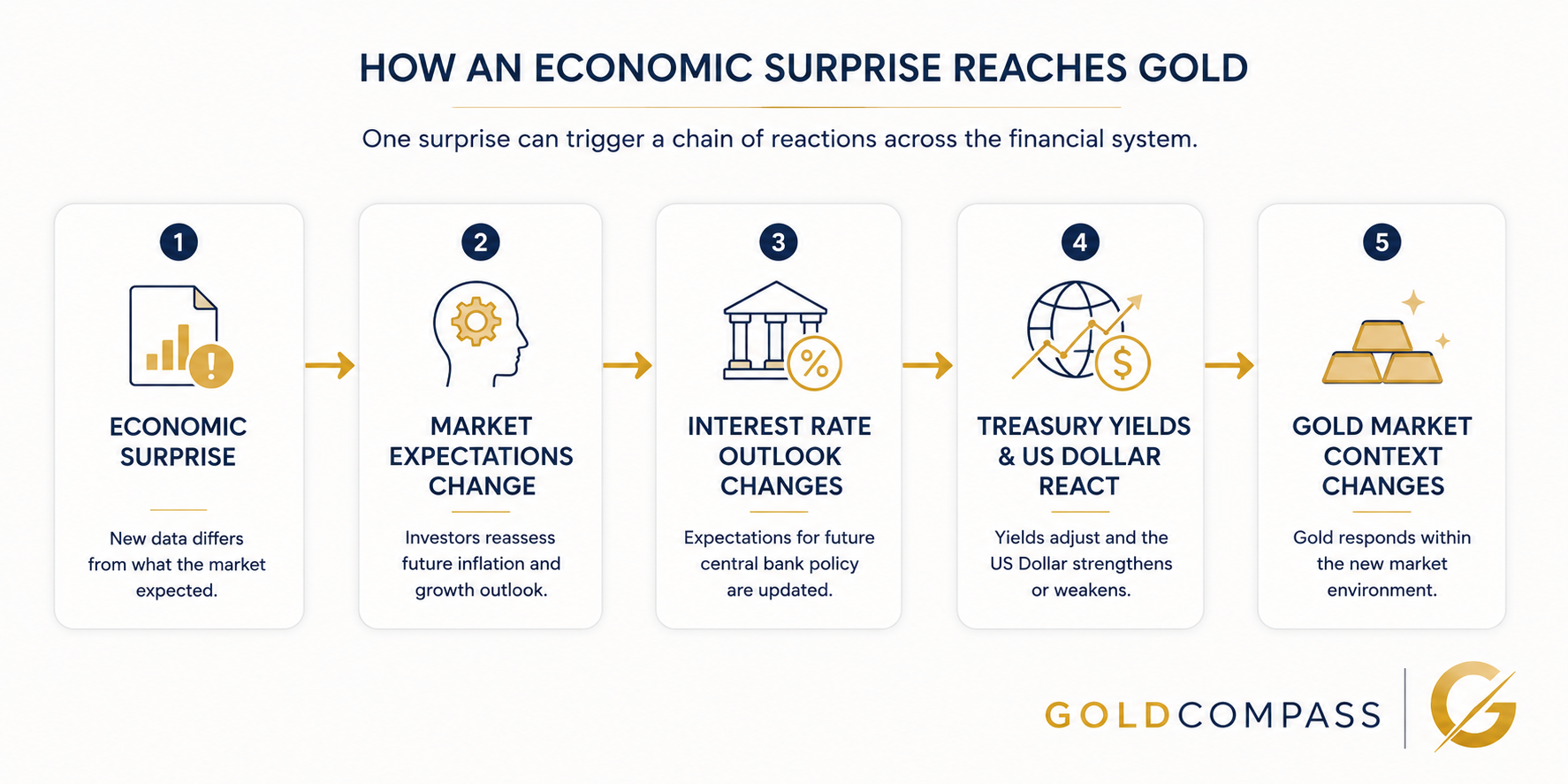
Economic data does not usually affect gold through one simple direct connection.
The information changes expectations first.
Imagine inflation comes in significantly hotter than expected.
Investors may conclude that inflation is more persistent than previously believed.
That could change expectations about future Federal Reserve policy.
Changing interest-rate expectations can influence Treasury yields.
Treasury yields and policy expectations can influence the US Dollar.
Gold then responds within this newly changed market environment.
The important lesson is simple:
Economic data changes expectations. Expectations change financial conditions. Gold reacts to the resulting market environment.
5. Why "Good News" Can Cause a Negative Reaction
This is one of the most confusing market behaviors for beginners.
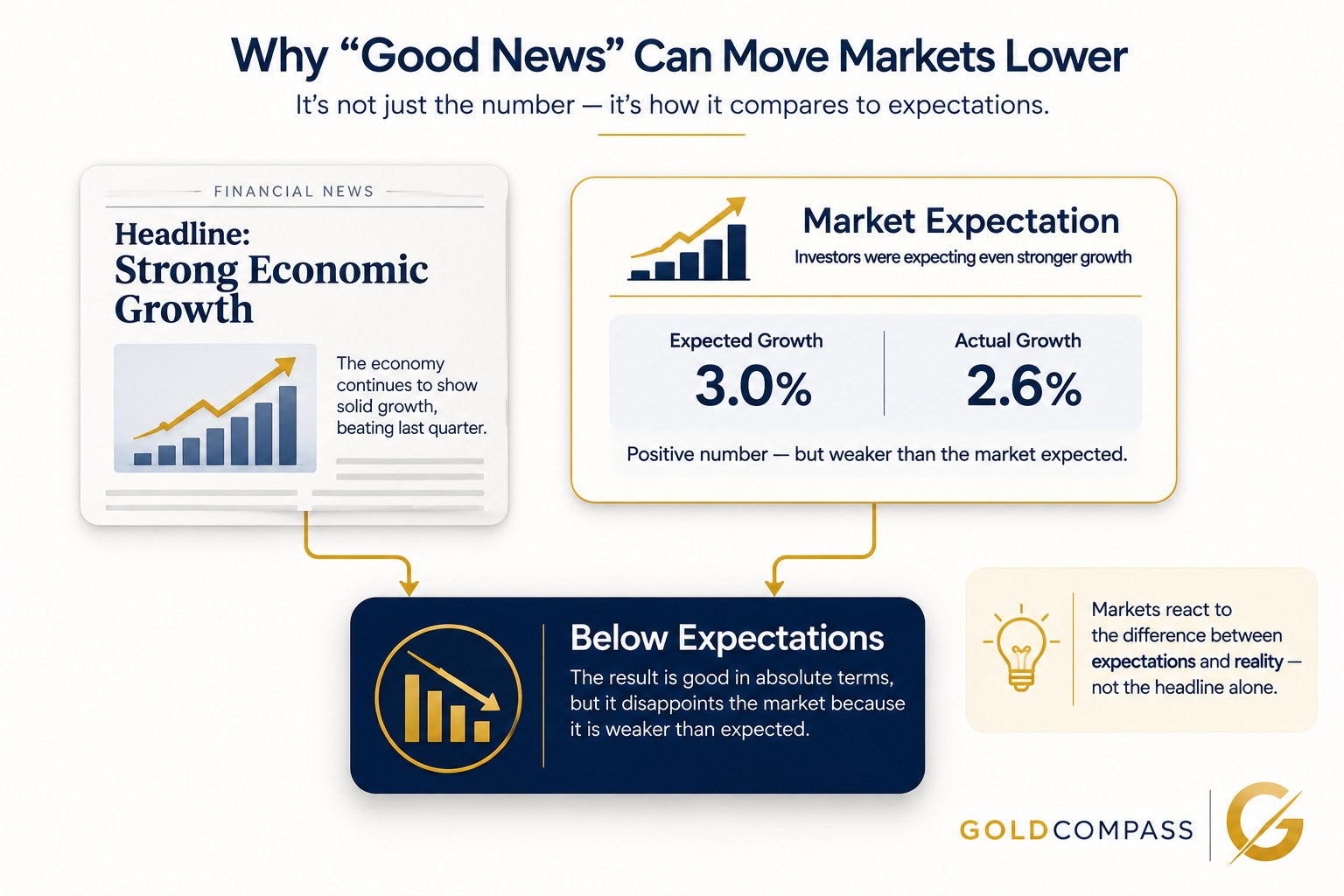
Suppose economic growth is strong.
That sounds positive.
But imagine the market expected growth to be even stronger.
The result can simultaneously be:
Good in absolute terms
and
Disappointing compared with expectations
Markets are reacting to the second part.
The reverse can also happen.
Economic data might look weak, but if investors expected something much worse, the result can actually be interpreted positively.
This is why headlines alone are often insufficient for understanding market movements.
6. Expectations Can Change Before the Report
The published forecast is useful, but market expectations are not frozen until the announcement.
They continuously evolve.
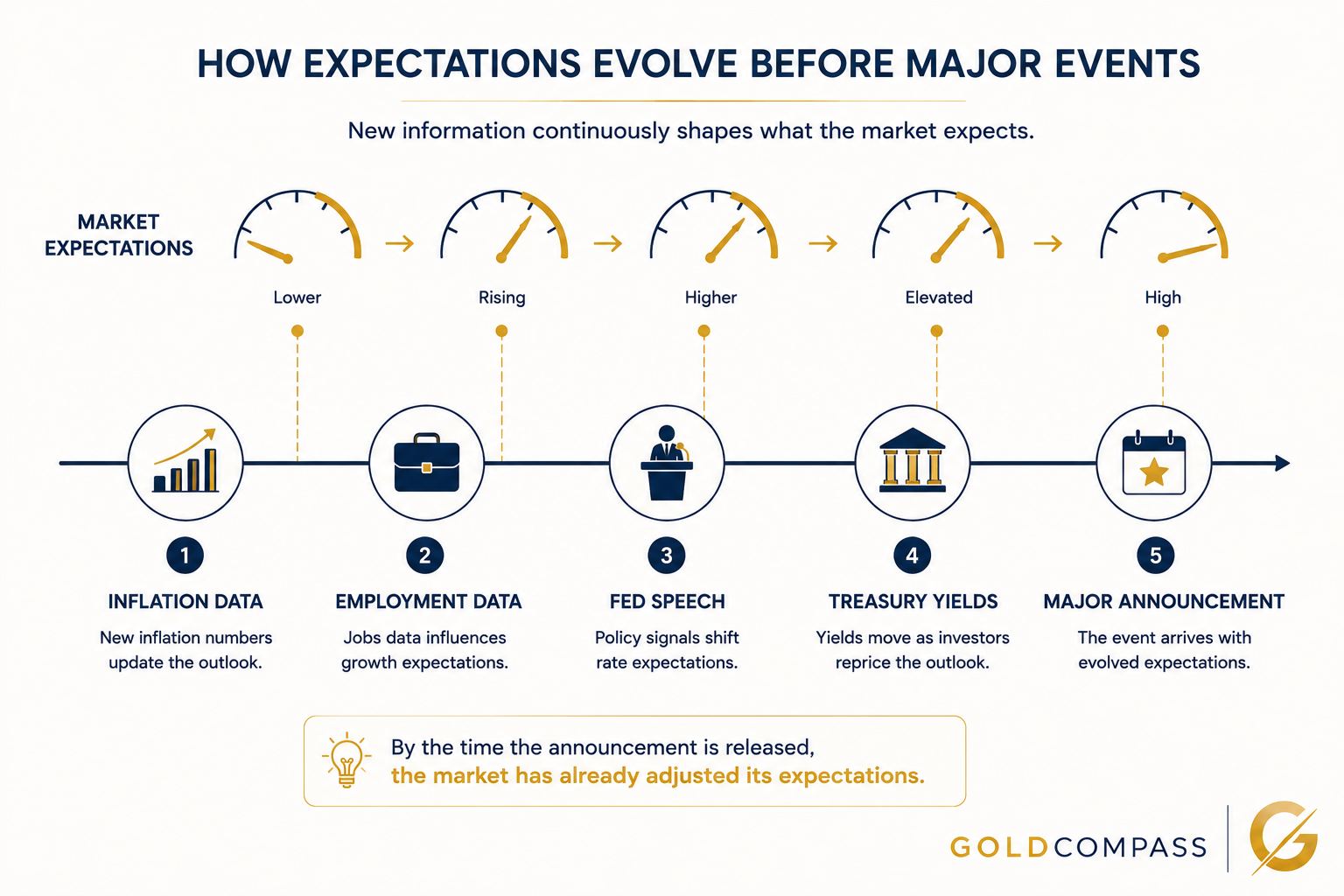
Before a major report, investors may receive new information from inflation reports, employment data, Federal Reserve speeches, consumer spending, business surveys, and financial markets.
Each new piece of information can change what investors believe will happen next.
For example, several unexpectedly strong economic reports before an FOMC meeting could change expectations about the Federal Reserve even before the meeting begins.
By the time the official decision arrives, part of the expected outcome may already be reflected in markets.
7. Why Gold Can Reverse After the Initial Reaction
Major economic releases often contain several pieces of information.
Consider an employment report.
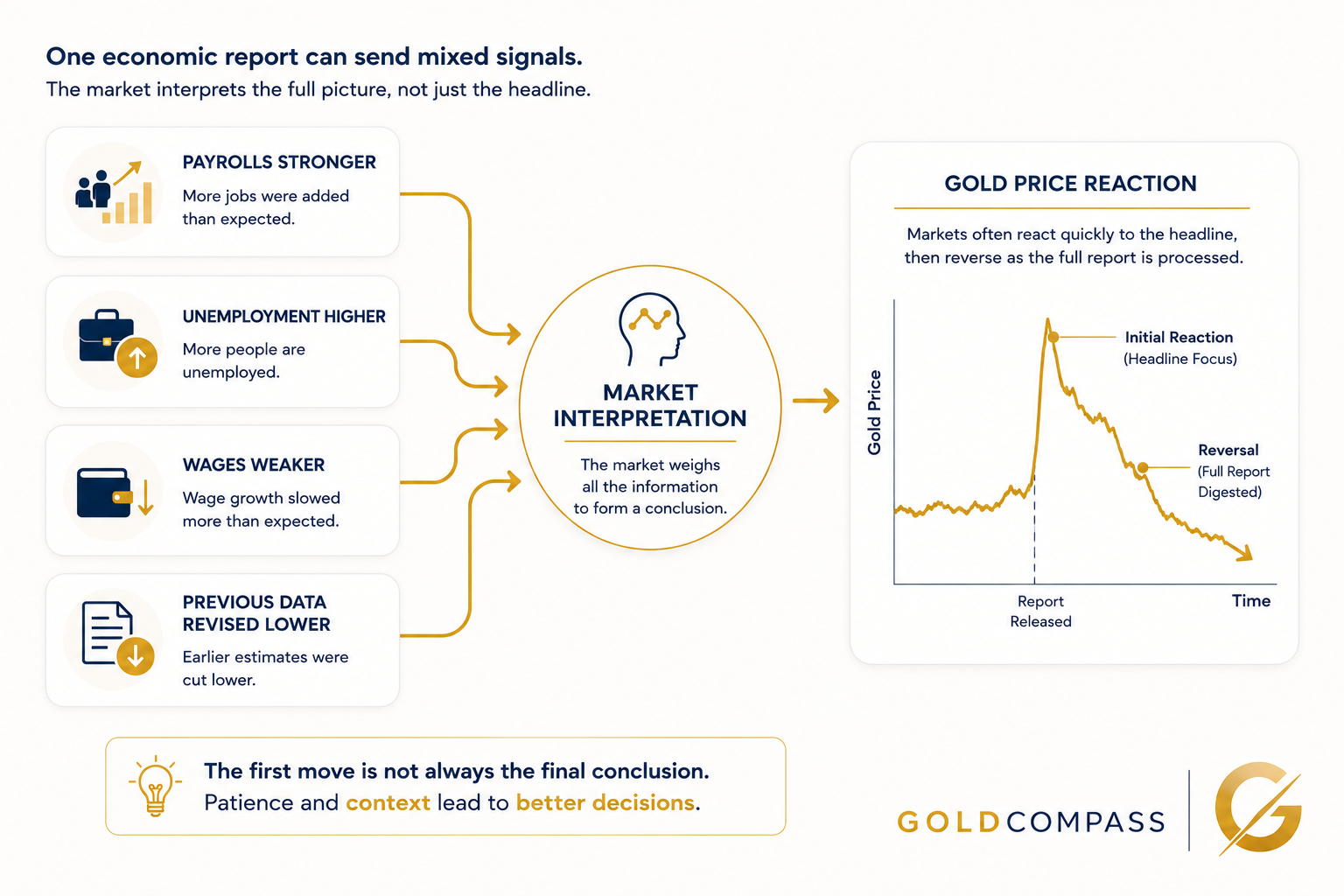
The headline may show stronger-than-expected job creation.
But deeper inside the same report, unemployment might rise, wage growth might weaken, and previous employment figures might be revised lower.
The report is no longer simply "strong."
It contains conflicting information.
Automated trading systems and market participants may initially react to the headline number.
As the complete report is processed, the interpretation can change.
Treasury yields and the US Dollar may also change direction.
Gold can therefore move sharply immediately after a release and then reverse.
The first move is not necessarily the market's final conclusion.
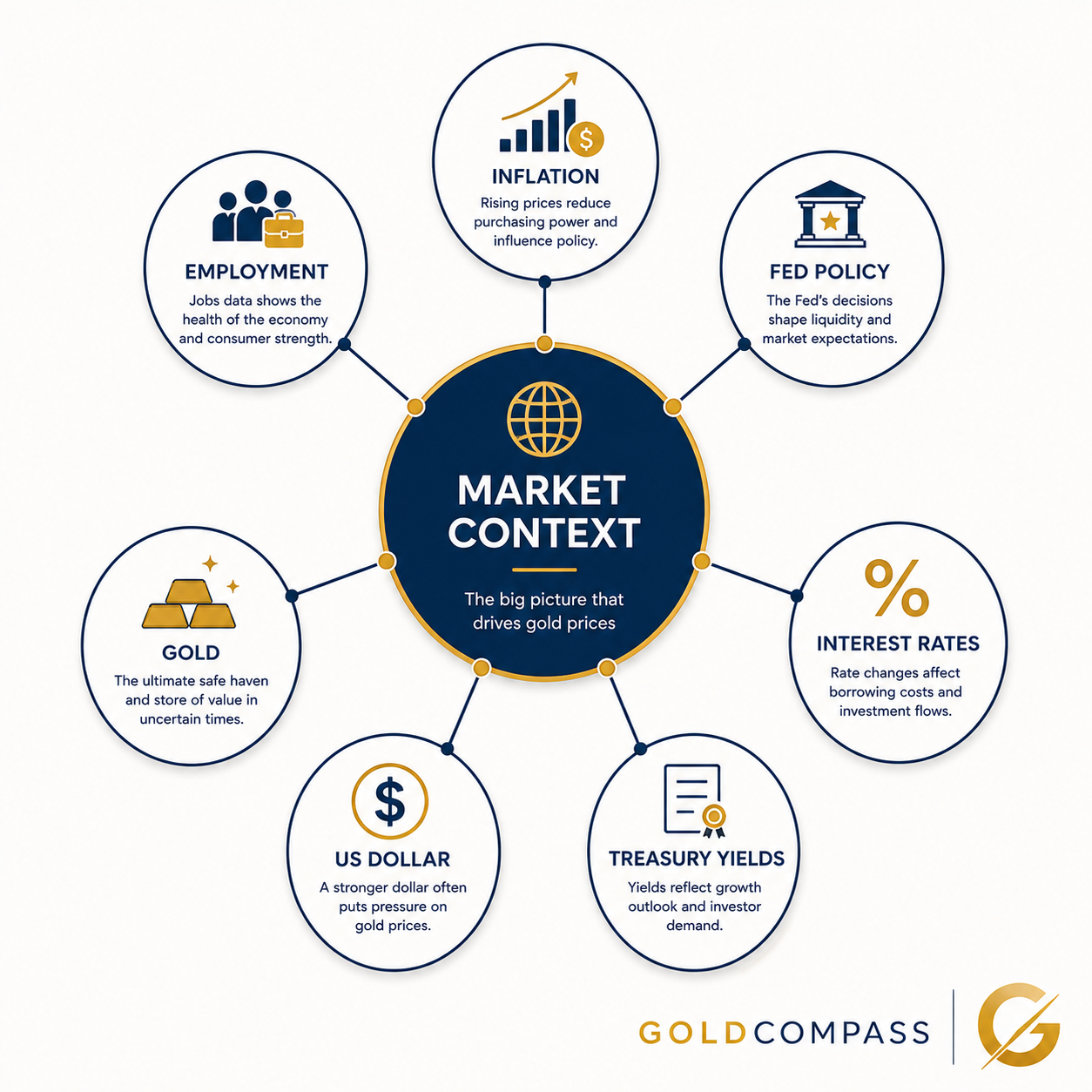
8. Market Context Determines What Matters Most
Not every economic surprise carries the same importance.
At one point, inflation may be the market's biggest concern.
At another, investors may be focused on employment.
During another period, recession risk or monetary policy may dominate attention.
This means the same economic report can produce different reactions at different times.
Before interpreting an announcement, consider what the market currently cares about most.
Ask whether the new information changes that existing story.
Then observe how important connected markets—particularly Treasury yields and the US Dollar—respond.
This provides much more information than the headline alone.
9. A Better Way to Read Economic News
When important economic data is released, avoid immediately asking:
Is this bullish or bearish for gold?
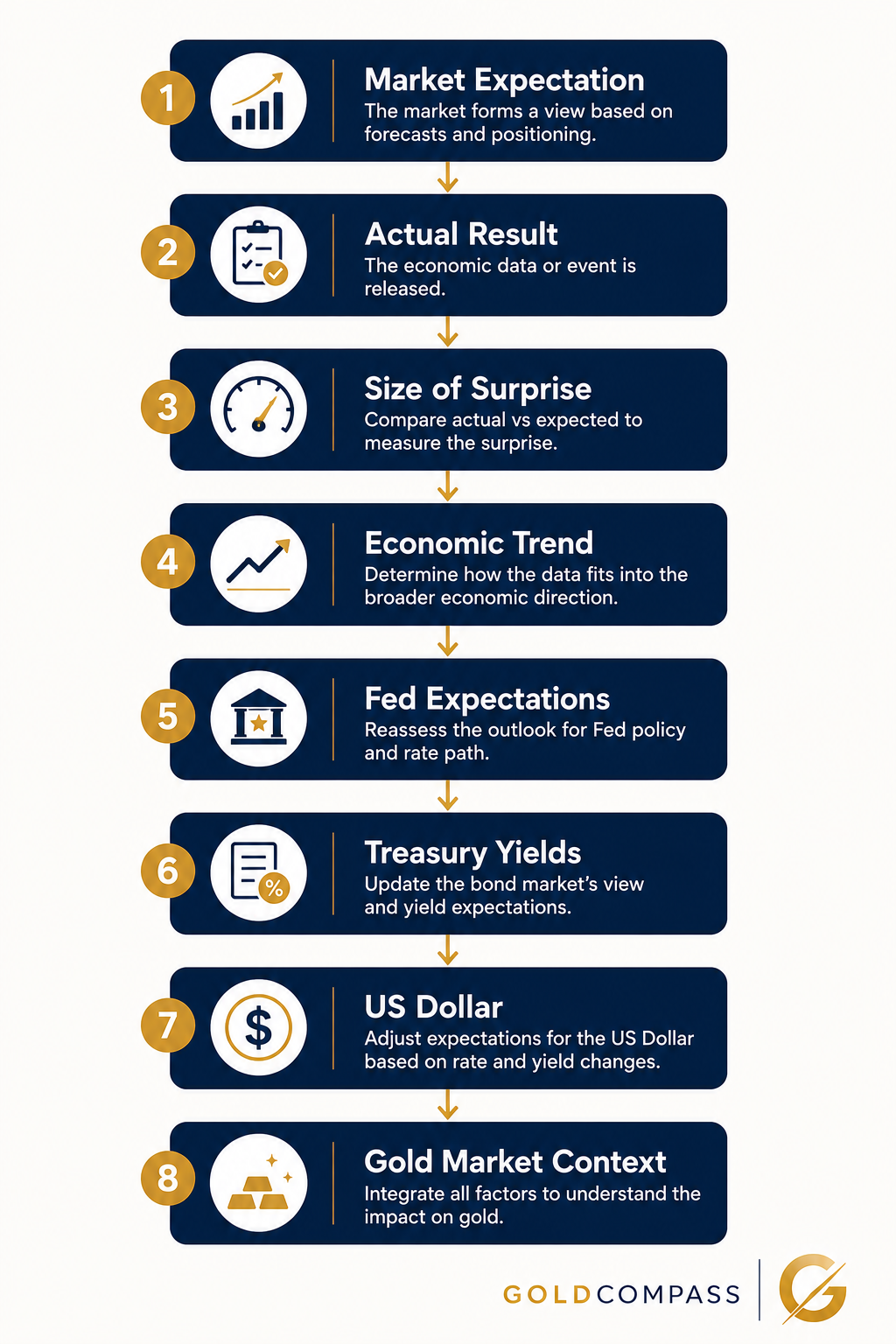
Instead, answer these questions in order.
First: What did the market expect?
Second: What was actually reported?
Third: Was the difference meaningful?
Fourth: Does the result change the existing economic trend?
Fifth: Does it change expectations about Federal Reserve policy?
Sixth: How are Treasury yields responding?
Seventh: How is the US Dollar responding?
Finally: How is gold behaving within this new environment?
This process separates the economic report from the market's interpretation of it.
That distinction is essential.
10. The Rule to Remember
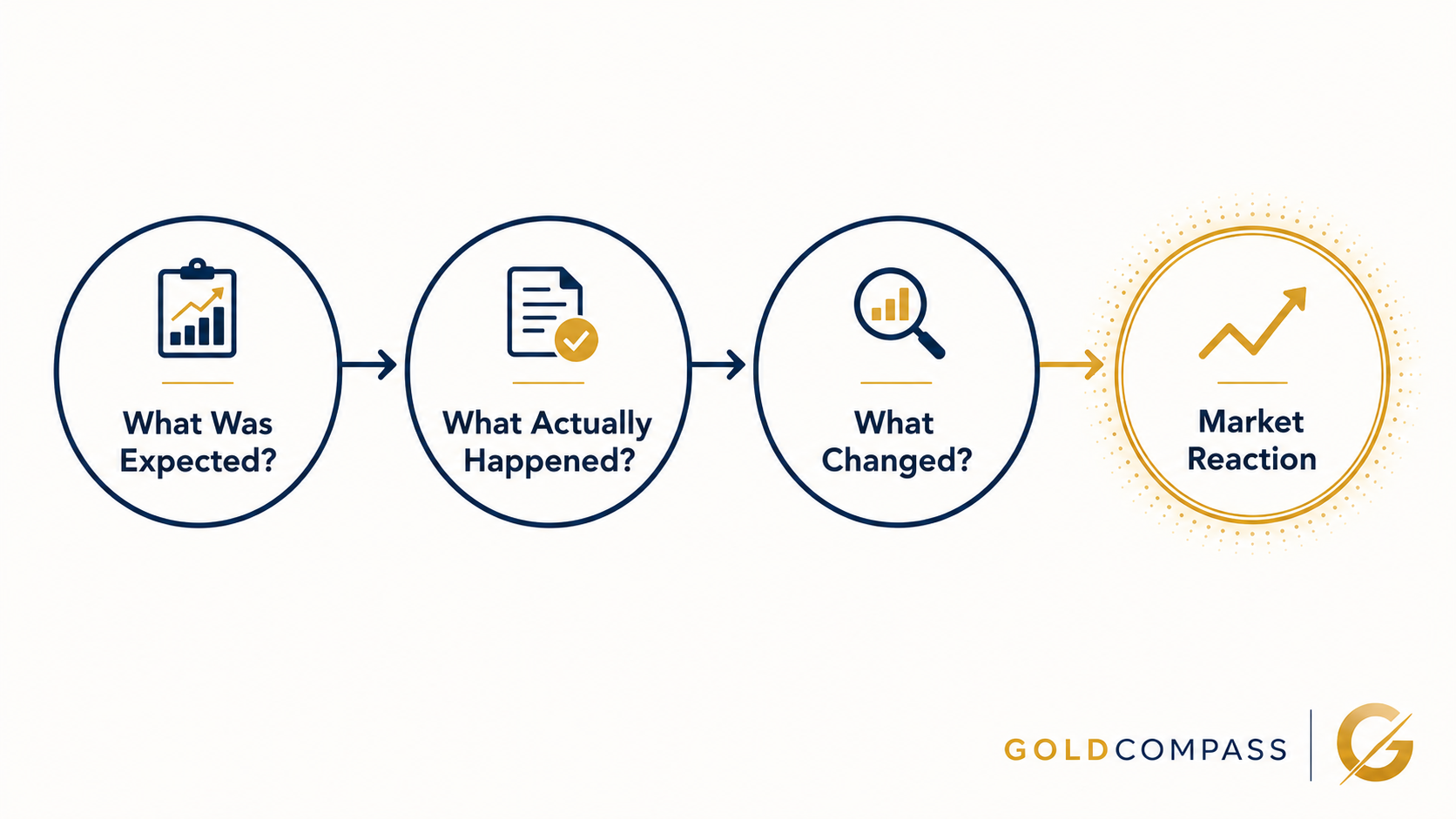
Whenever important economic news appears, remember three questions:
What was expected?
What actually happened?
What changed because of the difference?
This principle applies across many major economic events.
It helps explain reactions to inflation reports, employment data, economic growth, consumer spending, business activity, and central-bank decisions.
Once you understand expectations, many market movements that previously seemed irrational become easier to understand.
Key Takeaways
- Financial markets are forward-looking.
- Expectations can influence prices before economic data is officially released.
- Previous tells you what happened before, Forecast represents expectations, and Actual provides the new result.
- The difference between Forecast and Actual can be more important than the headline number itself.
- A result can be objectively positive but still disappoint markets if expectations were higher.
- Economic surprises can change Federal Reserve expectations, Treasury yields, the US Dollar, and gold's broader market environment.
- Expectations evolve as new information becomes available.
- Initial market reactions can reverse when reports contain conflicting information.
- No economic report should be treated as a guaranteed directional signal for gold.
Frequently Asked Questions
What does "priced in" mean?
Priced in means investors already expected an event or result and have adjusted market prices before the event actually occurs.
Why can a major economic report produce almost no reaction?
If the result closely matches expectations, the market may receive very little new information.
What is an economic surprise?
An economic surprise is a meaningful difference between what the market expected and what was actually reported.
Which matters more: Previous, Forecast, or Actual?
All three provide useful context. Immediately after a release, the difference between Forecast and Actual is often especially important because it shows whether expectations were correct.
Does a bigger surprise always cause a bigger gold move?
No. Market positioning, liquidity, Treasury yields, the US Dollar, other details within the report, and the broader macroeconomic environment can all affect gold's reaction.
Why can gold move one way and then quickly reverse?
The first reaction may focus on a headline figure. As investors process the rest of the report and observe reactions in Treasury yields and the US Dollar, the market's interpretation can change.