How Do Interest Rates Affect Gold?
Interest rates are one of the most closely watched economic indicators in the financial markets.
Whenever a central bank announces a rate decision, traders across the world pay attention—not only in the bond and currency markets, but also in gold.
Why?
Because interest rates influence how attractive different investments become.
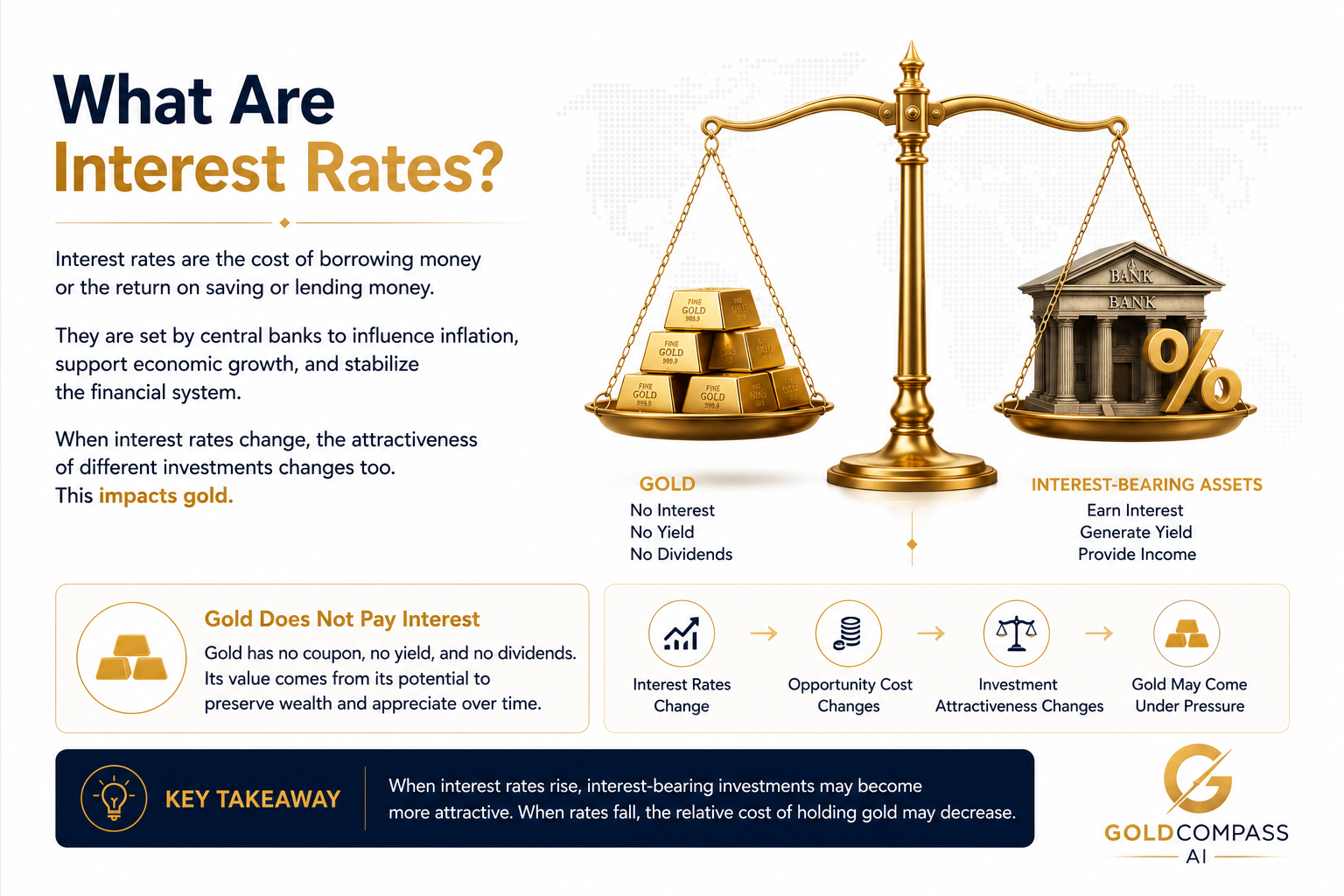
Unlike savings accounts or government bonds, gold does not generate interest. Investors own gold because of its potential to preserve value and appreciate over time, not because it produces income.
When interest rates rise, interest-bearing investments may become more attractive to some investors. When rates fall, the relative cost of holding gold may decrease.
However, interest rates are only part of the story.
Markets often react more strongly to what investors expected than to the actual rate decision itself.
This is why experienced traders focus not only on today's interest rate, but also on central bank guidance, inflation expectations and future policy outlook before evaluating gold.
 ## Why Do Higher Interest Rates Usually Put Pressure on Gold?
Imagine you have two investment options.
The first is a government bond that pays a higher interest rate.
The second is gold, which does not generate interest or dividends.
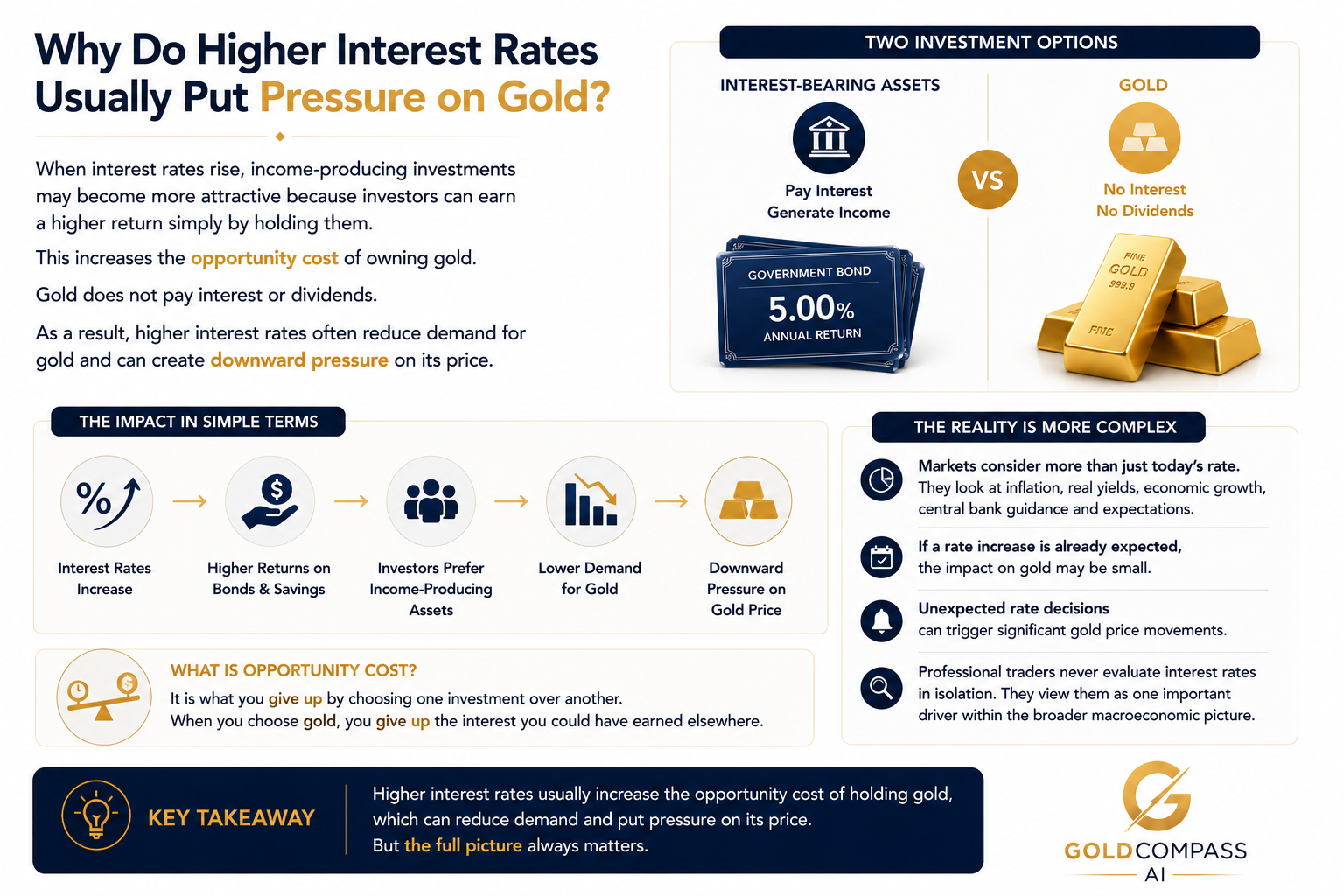
As interest rates increase, income-producing investments may become more attractive because investors can earn a higher return simply by holding them.
This increases the opportunity cost of owning gold.
The opportunity cost is what you give up by choosing one investment over another. When you choose gold, you give up the interest you could have earned elsewhere.
For this reason, higher interest rates often reduce demand for gold and can create downward pressure on its price.
However, this relationship is not automatic.
Markets don't react only to today's interest rate. They also consider inflation, real yields, economic growth, central bank guidance and investor expectations.
A rate increase that has already been anticipated by the market may have little effect on gold. On the other hand, an unexpected rate decision can trigger significant price movements.
This is why professional traders never evaluate interest rates in isolation. They view them as one important driver within the broader macroeconomic picture.
 ## Why Do Markets React More to Expectations Than the Actual Rate Decision?
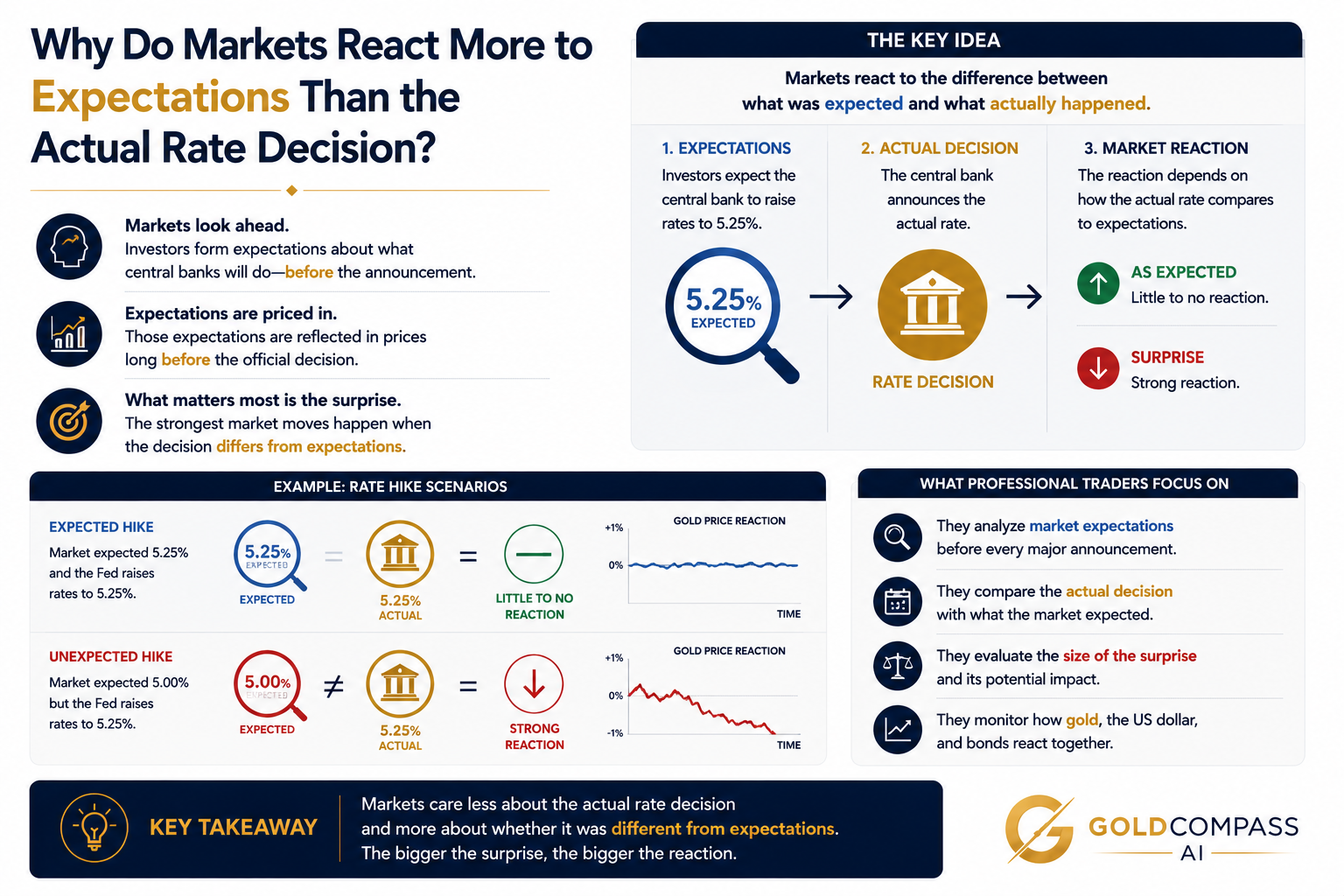
One of the biggest surprises for new traders is that gold doesn't always move after an interest rate announcement—even when rates change.
That's because financial markets constantly look ahead.
Before every central bank meeting, investors form expectations about what they believe will happen. Those expectations are reflected in prices long before the official announcement.
If the central bank delivers exactly what the market expected, gold may barely react because the information was already priced in.
The strongest market moves usually happen when the decision differs from expectations.
For example, if investors expected interest rates to remain unchanged but the central bank unexpectedly raises rates, the surprise can trigger a sharp reaction across gold, the US dollar and bond markets.
Professional traders spend just as much time analyzing market expectations as they do analyzing the actual decision.
This is why experienced traders don't simply ask:
"What did the central bank do?"
They ask:
"Was the decision different from what the market expected?"
Understanding this difference helps explain why two identical interest rate decisions can produce completely different market reactions.
 ## What Do Professional Traders Watch Before a Rate Decision?
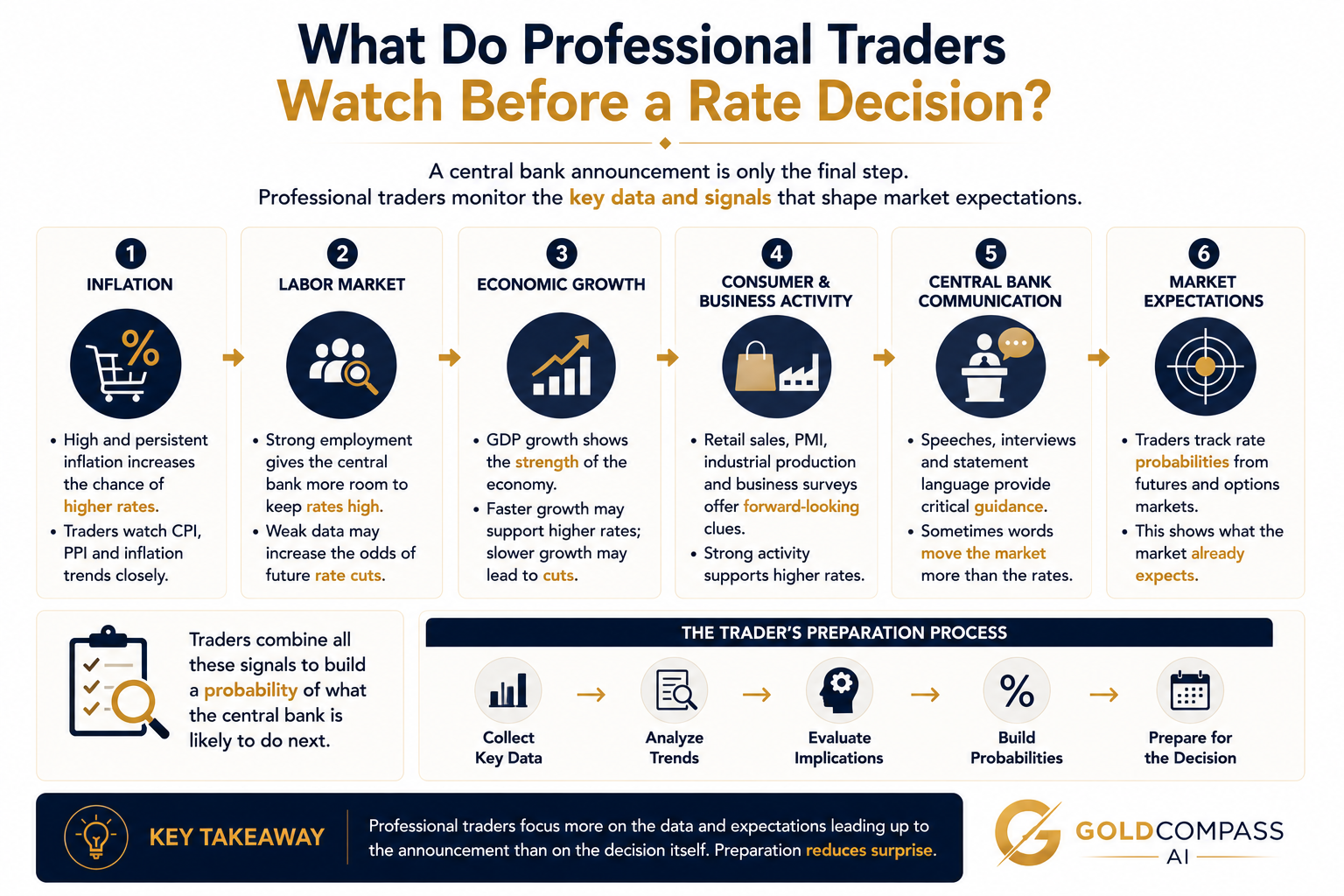
A central bank announcement is only a small part of the analysis.
Long before the decision is released, professional traders monitor the economic data that influences policymakers and shapes market expectations.
They pay close attention to inflation because persistent inflation may increase the likelihood of higher interest rates.
Employment data is another key indicator. A strong labor market can give central banks more room to keep interest rates elevated, while weaker employment figures may increase the possibility of future rate cuts.
Economic growth, consumer spending and business activity also provide clues about the overall health of the economy and the direction of future monetary policy.
Perhaps most importantly, traders listen carefully to speeches and statements from central bank officials. Sometimes the words used during a press conference move the market more than the interest rate decision itself.
By combining these signals, traders build a probability—not a prediction—of what the central bank is likely to do next.
This preparation helps explain why experienced traders are rarely surprised by major policy decisions. They spend more time understanding the environment leading up to the announcement than reacting after it has already happened.
 ## How GoldCompass AI Helps You Prepare for Rate Decisions
Preparing for a central bank decision requires more than checking the announcement time.
Traders need to understand the economic conditions shaping policy expectations before the event begins.
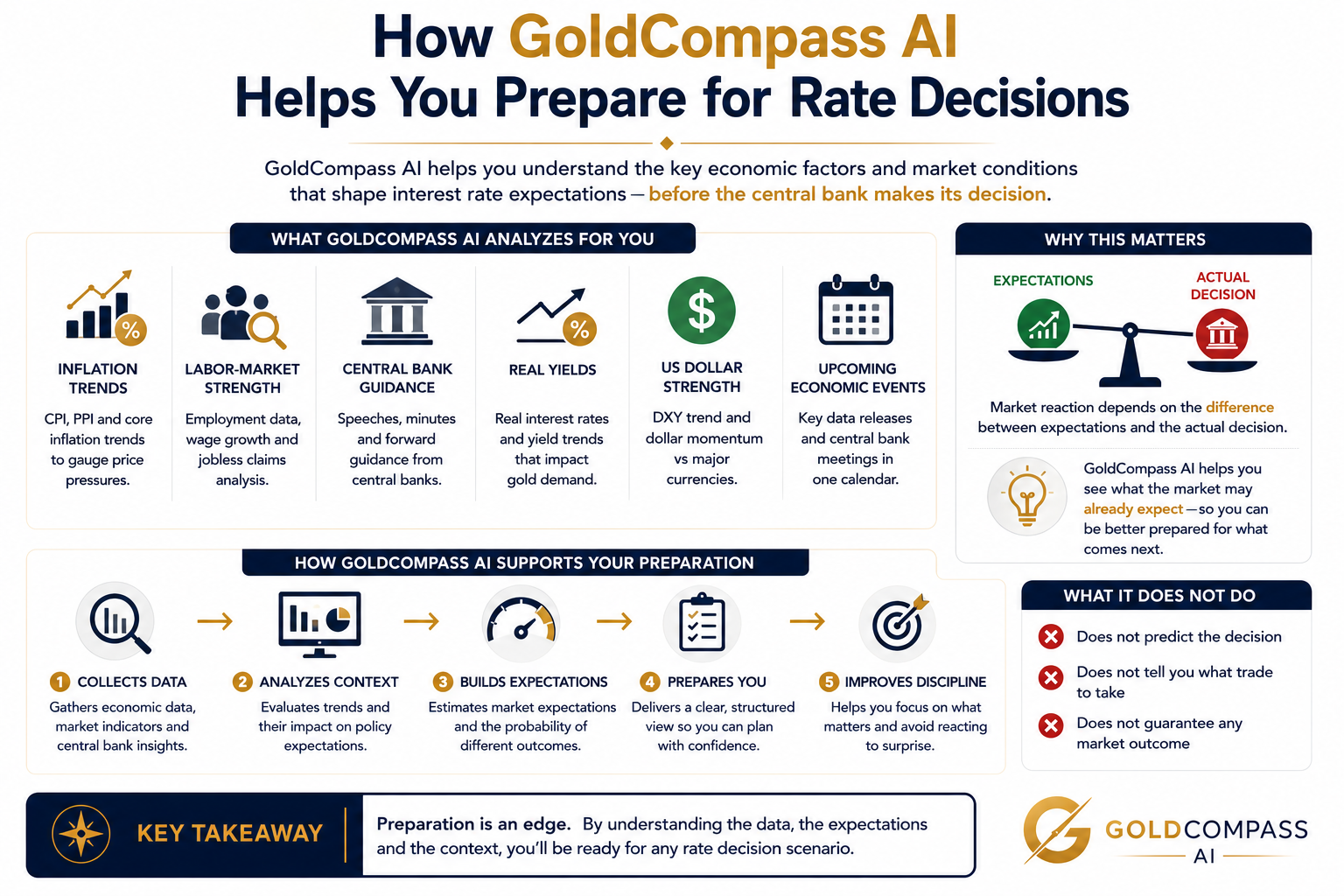
GoldCompass AI helps organize the key information that matters most, including inflation trends, labor-market strength, central bank guidance, real yields, the US dollar and upcoming economic events.
By viewing these factors together, traders can build a clearer picture of what the market may already expect.
This matters because the size of the market reaction often depends on the difference between expectations and the actual decision.
GoldCompass AI is designed to support this preparation by presenting relevant market context in a structured and understandable way.
It does not predict the decision or tell users what trade to place.
Instead, it helps users approach major rate events with better context, clearer expectations and a more disciplined analysis process.